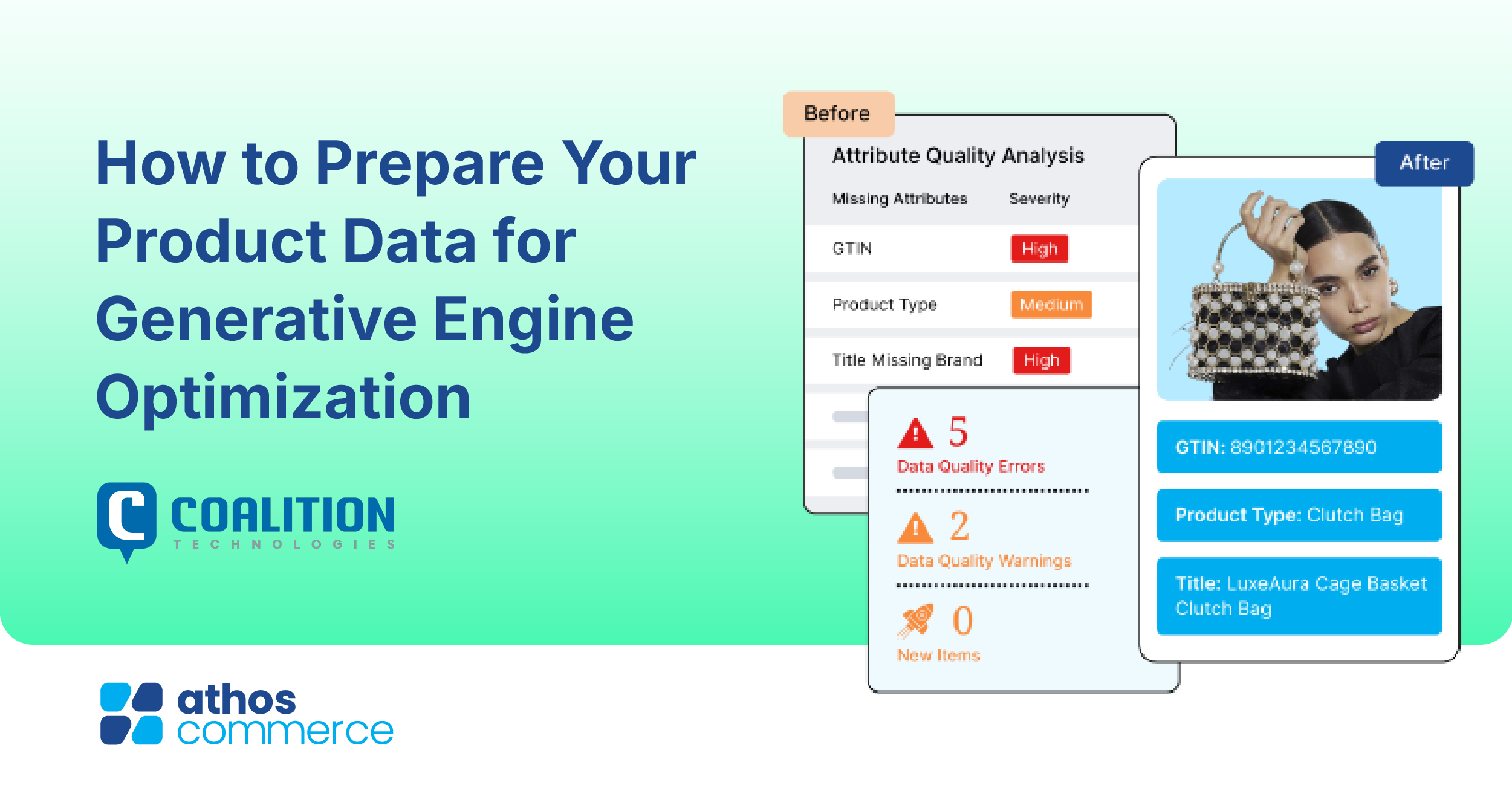












Market expansion means growing your ecommerce business by reaching new customers through new channels, new regions, or new products. The work slows down when product data has to be rebuilt for every destination, but a single structured product record makes each new market routine.
Retailers usually know where their shoppers are heading. Reaching them on a new marketplace or in a new region still feels like a large project, because thousands of products have to match each channel’s rules. Worries about broken listings and stale prices push expansion to next quarter. It does not have to work that way. A clear market expansion strategy, backed by well-structured product data, turns each new channel into a repeatable move instead of a fresh build. The real difference in business growth comes down to how product data is built and reused across every market.
What is market expansion for ecommerce brands?
Market expansion is the process of growing revenue by selling to new customers beyond your current reach. For an online store, that reach grows in several directions at once.
What does market expansion mean?
Market expansion means finding new demand for your products and building a path to serve it. Sometimes that path is a new sales channel. Sometimes it is a new region or a new market segment. Every version shares one goal: more customers without a matching rise in cost or risk. The clearest value proposition is meeting your target audience where they already shop.
What are the main market expansion strategies?
Most ecommerce teams grow through one or more of these moves:
- New sales channels: Listing on marketplaces like Amazon, Walmart, and eBay, plus social platforms such as TikTok Shop, puts your catalog in front of shoppers who never visit your site.
- New regions: Selling into international markets or a single overseas market opens demand that your existing market cannot supply on its own.
- New customer segments: Adjusting price points, bundles, and messaging lets you serve the specific needs of new customer segments and widen your customer base.
- New products: Product development and a new product line give current buyers more reasons to purchase and lift your market share.
A strong plan blends channel growth with real market research on where demand actually sits.
Why does entering a new market or channel take so long?
Adding a marketplace looks simple on a slide and turns heavy in practice. The cost hides in the product data.
What makes each channel expensive?
Every marketplace has its own product data rules. Walmart wants attributes one way, eBay wants another, and each social storefront sets its own limits on titles, images, and categories. Adding a channel means rewriting titles and attributes, meeting image standards, and wiring price and inventory sync. Multiply that across a large catalog and one new channel can cost as much as running a second store. That expense is why teams treat their distribution channels as separate projects instead of a step toward wider market reach.
Where does the effort come from?
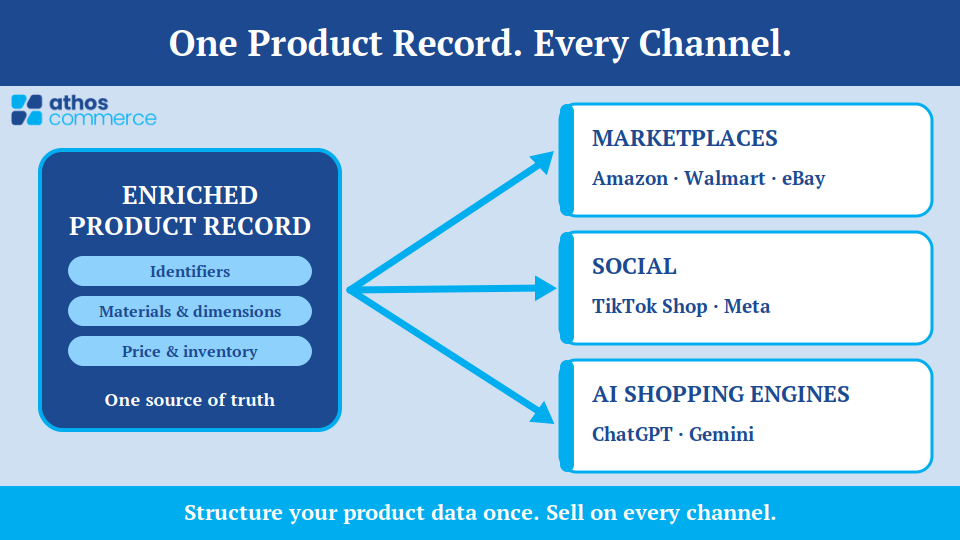
Most catalogs were built once for the website, then patched channel by channel in spreadsheets and seller consoles. Over time the versions drift apart. Prices lag, feeds carry last season’s copy, and no single record holds the truth. Online marketplaces now generate roughly 83% of global ecommerce sales, which means the channels you want to reach are the same ones this manual work makes hardest to enter.
Ecommerce reached 20.5% of global retail sales in 2025 and is projected to hit 22.5% by 2028, so the pressure to be on every channel keeps rising.
“A single persona of product data is now not enough.”
Mark Batson, Head of Go-to-Market Technical Operations, Athos Commerce
How do you make market expansion routine instead of risky?
The fix is not more people. It is a better operating model built on one enriched product record.
Can you add a channel like you add a SKU?
Think about how a team adds a product. Someone enters it once, the attributes populate, and it flows wherever it needs to appear. Adding a marketplace can feel the same once the brand holds one enriched product record instead of many channel-specific copies. That record carries the master attributes that never change, such as identifiers, materials, and dimensions. Channel-aware treatments layer on top, so the Google title, the Walmart attribute set, and the social headline all come from one source. The second channel then costs a fraction of the first.
What makes expansion fast and safe?
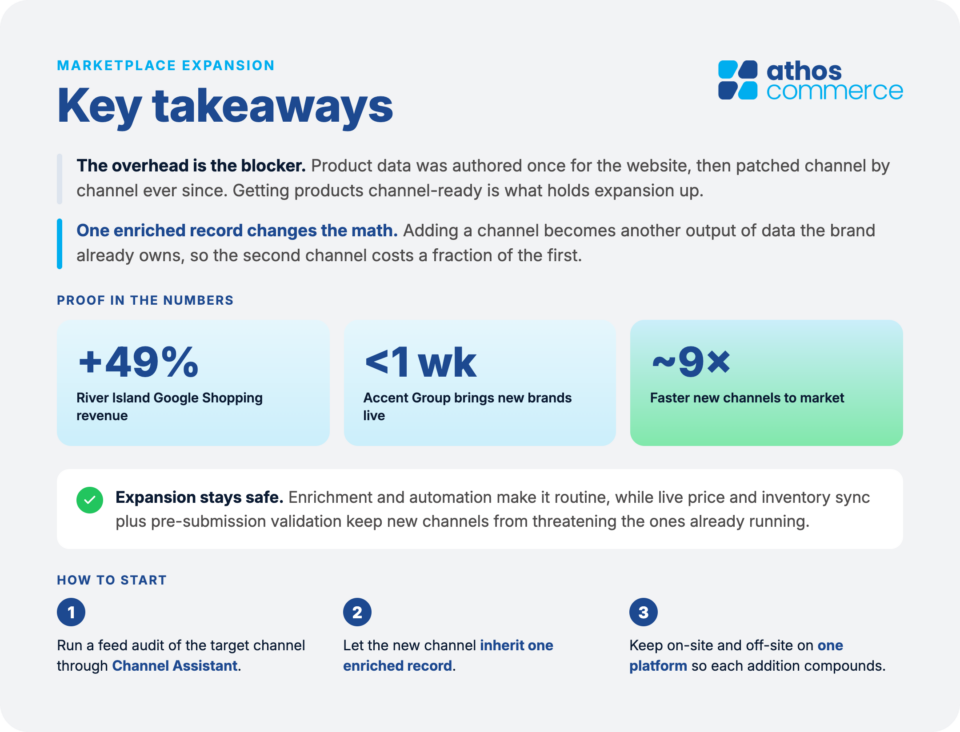
Two capabilities carry the load. Enrichment shapes the canonical record into channel-ready versions without a person rewriting each one. Automation audits the data, builds every variant, and validates listings before a marketplace can reject them. Live price and inventory sync means a new channel never sells what you cannot fulfill. River Island used this approach to grow revenue on Google Shopping by 49%, without a new catalog or a separate team.
What does a strong market expansion strategy look like?
A brand does not have to solve every channel at once. A short, ordered plan turns expansion from a gamble into a growth strategy you can repeat.
Which markets should you prioritize?
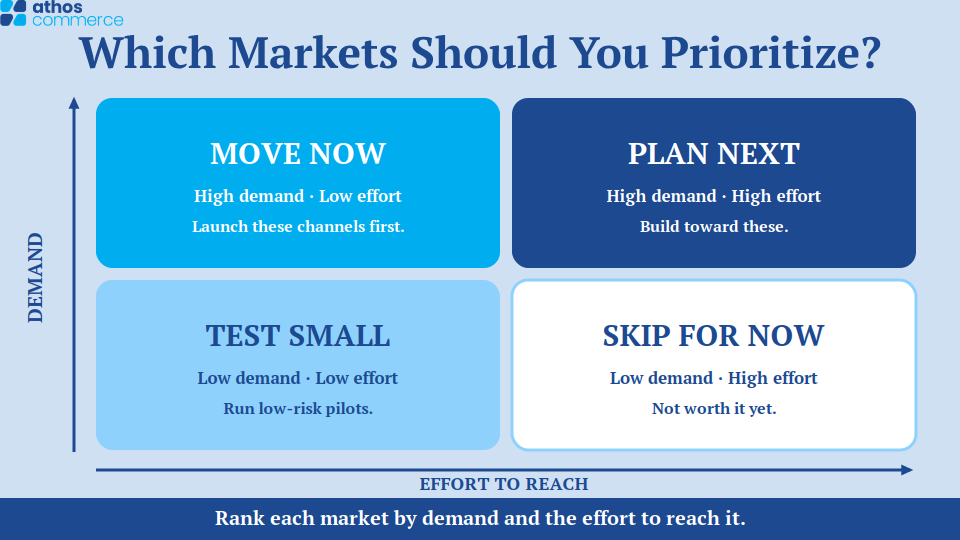
Start with market research, not a hunch. Look at where your shoppers already spend time and study consumer behavior to spot untapped markets with real demand. Rank each potential market by growth potential, fit with your existing product, and the effort to reach it. That ranking points your marketing efforts and financial investment at the new opportunities most likely to pay off. It also supports sustainable growth and long-term sustainability rather than a short spike.
What belongs in a market expansion checklist?
Three moves, taken in order, make expansion a capability instead of a one-off:
- Audit before you commit: Run an automated feed audit against the target marketplace’s rules before you add headcount or a deadline, then make the go decision on evidence.
- Let each channel inherit one record: Point every new channel at a single enriched product record and generate its version from there, which drops the cost of the second channel well below the first.
- Keep every channel on one platform: Managing search, merchandising, and feeds on one system means each new market builds on work already done instead of starting over.
| Factor | Manual, channel-by-channel | One enriched product record |
| Time to launch a channel | Weeks to months | Days |
| Cost per added channel | Roughly flat each time | Falls with each channel |
| Listing errors | Caught after rejection | Caught before submission |
| Data accuracy | Drifts across channels | One trusted source |
“When we add a new brand to our portfolio, we simply provide the source feed to Athos Commerce, and the brand goes live within a week. The onboarding is incredibly fast.”
Hayley Sward, Digital Marketing Manager, Accent Group
Athos Commerce: Your Partner in Market Expansion
Market expansion rewards the brands that move first. When a new channel takes days instead of months, you reach shoppers across the United States and the global market while competitors are still scoping the work. That speed comes from structured product data and one platform behind every channel.
Athos Commerce is the AI product discovery and feed management platform built for that pace. It unifies search, personalization, merchandising, and product feed management, and its Channel Assistant audits your data against a marketplace’s rules, fixes issues, and syndicates channel-ready listings across 1,400+ destinations in hours. Brands like Accent Group, Crew Clothing, and JD Sports use it to enter new markets without the manual grind. Your product data becomes a single source that every marketplace, social channel, and AI shopping engine can read.
Ready to make your next market the easy one? See how Athos Commerce handles marketplace expansion and turn your next channel into a routine step.
Sources & Further Reading
- Athos Commerce. “River Island Case Study.” Athos Commerce, 2026. https://athoscommerce.com/case-studies/river-island/.
- Athos Commerce. “Accent Group Case Study.” Athos Commerce, 2026. https://athoscommerce.com/case-studies/accent-group/.
- Athos Commerce. “Marketplace Management.” Athos Commerce, 2026. https://athoscommerce.com/products/marketplace-management/.
- Gartner. “Gartner Unveils Top Predictions for IT Organizations and Users in 2026 and Beyond.” Gartner Newsroom, October 21, 2025. https://www.gartner.com/en/newsroom/press-releases/2025-10-21-gartner-unveils-top-predictions-for-it-organizations-and-users-in-2026-and-beyond.
Frequently Asked Questions
What is market expansion in ecommerce?
Market expansion in ecommerce is the process of growing sales by reaching new customers through new channels, new regions, or new products. It covers listing on additional marketplaces, selling into international and foreign markets, and serving new customer segments.
What is a market expansion strategy?
A market expansion strategy is the plan a brand follows to enter a new market in an orderly way. It ranks each potential market by demand and effort, decides how product data will reach the channel, and sets the marketing strategy and tools that keep listings accurate.
What is the difference between market penetration and market expansion?
Market penetration means selling more of an existing product inside an existing market, often through marketing campaigns and sharper pricing. Market expansion, sometimes called market development, means reaching a new market or channel you do not serve yet. Most brands use both over the long term as part of one growth plan.
What is the next step to expand into new markets safely?
The next step is a feed audit against the target channel’s rules before you commit budget or headcount. The audit shows the blocking issues in days and turns a guess into an evidence-based decision. From there, point the channel at one product record and publish.