














Limitless Extensibility
Deliver high-relevance experiences across all touchpoints from discovery channels to headless storefronts.

Webinars, eBooks, checklists, and research to help you get ready, rally through peak, and turn Black Friday shoppers into repeat buyers.
Get the freedom to build unique experiences and connect your intelligence to any ecosystem with ecommerce API integration.
Give your development and commerce teams the freedom to build custom experiences and connect merchandising intelligence to any part of their tech stack. From RESTful APIs and near real-time data sync to pre-built connections across platforms, marketplaces, and marketing tools, Athos removes the infrastructure complexity that slows teams down.


Use flexible APIs and pre-built UI components to seamlessly integrate the Athos platform with your e-commerce site and build custom discovery, merchandising, and personalization across any touchpoint.

Launch faster with pre-built connections to leading e-commerce platforms, marketplaces, and marketing tools and save your team weeks of custom integration work.

Add new channels, storefronts, or tools to your commerce stack without rebuilding your infrastructure so your technology scales as fast as your business.
RESTful APIs, platform connectors, and JavaScript libraries give your team full control to build and integrate across any channel, while Snap, Snap Templates, and Managed Implementations make it easy for any team to get up and running fast.
Pre-built connections to Shopify, BigCommerce, Amazon, eBay, Klaviyo, TikTok Shop, Google Shopping, and more let your team sync data, launch new channels, and scale across your full commerce ecosystem without IT complexity.

Deliver high-relevance experiences across all touchpoints from discovery channels to headless storefronts.

Standardized endpoints enable simple implementation for every new channel.

Feed shopper intent into reporting and analytics for actionable insights.

Surface query and clickstream data directly into reporting for immediate action.

From JavaScript libraries and open-source SDKs to no-code templates and managed implementations, connect your stack your way.

Connect Shopify, BigCommerce, Adobe Commerce, Salesforce Commerce Cloud, and SAP Commerce Cloud out of the box.

Sync product data and orders across Amazon, eBay, Mirakl, Myer, The Iconic, Kogan, Bunnings, and Qantas.

Connect your commerce data to Klaviyo, Dotdigital, and Yotpo to power smarter, data-driven marketing campaigns.

Sync your product catalogue with TikTok Shop to keep inventory live and convert social shoppers instantly.

Push optimized product data to Google Shopping, Google Local Inventory Ads, and Social Media Advertising channels automatically.
Smarter integrations delivering 110% uplift in revenue

performance uplift in just 30 days
SKUs reactivated through feed optimization

The onboarding process was smooth and seamless. From day one and continuing now, the local support has been outstanding. Our partnership with Athos Commerce is easily one of the most intuitive and supportive vendor relationships we have experienced.
Athos Commerce offers both fully managed integrations and flexible APIs, so the level of developer involvement depends on what you want to build. Pre-built platform connectors can be implemented with minimal development effort. The APIs are designed for teams that want to build custom experiences and custom integrations, with standardized RESTful endpoints and detailed documentation to reduce implementation time.
Most platform integrations with Shopify, BigCommerce, Adobe Commerce, and Salesforce Commerce Cloud can be completed in days, not weeks. The integration process relies on pre-built connectors that handle the heavy lifting, so your team isn’t writing custom code. Your dedicated onboarding team supports the setup from initial connection through to go-live.
Yes. Athos Commerce is a hybrid headless solution that provides RESTful APIs for teams building decoupled or composable storefronts alongside fully managed UI tools for day-to-day commerce operations. Whether you’re building on a headless stack or a traditional platform, the APIs give your development team full control to create custom experiences without being constrained by the frontend layer.
Yes. Athos Commerce is built to let you add new channels, platforms, and tools incrementally without rebuilding your existing infrastructure. Standardized API endpoints mean new integrations slot into your stack cleanly, and pre-built connectors for marketplaces, marketing automation tools, and social commerce platforms are designed to work alongside your existing setup from day one.
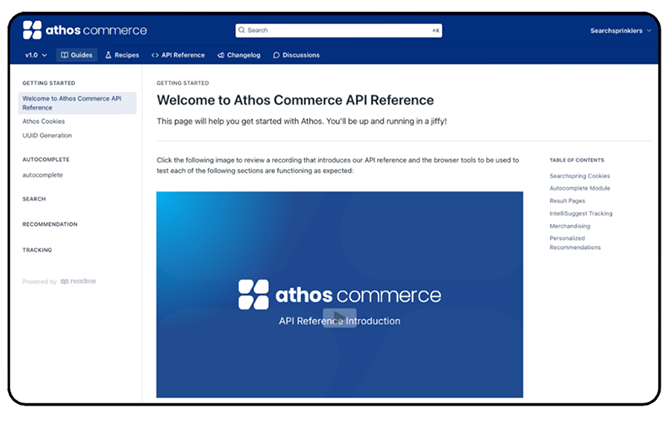
Athos Commerce provides a full API Reference portal with guides, recipes, changelogs, and discussion forums to help your development team get up and running quickly. Alongside documentation, your team has access to dedicated technical support throughout implementation and beyond so you’re never left to figure it out alone.
Ecommerce API integration links Athos to the different systems that run your e-commerce website, including your e-commerce platform, marketplaces, and third-party integrations. An application programming interface lets these software systems share data automatically instead of relying on manual processes. This API integration keeps your product data and inventory data accurate across every channel. The result is smoother business processes and better operational efficiency.
Athos focuses on product discovery, search, and merchandising, and it works alongside the payment gateways and payment processors your store already uses. Your checkout, shopping cart, and online payments stay with your ecommerce platform, while Athos handles how shoppers find products. Because Athos connects through standardized APIs, it fits into your existing setup without disrupting your payment APIs. This lets you keep the checkout experience your customers already trust.
Athos protects customer data and API keys with standard security controls that guard against unauthorized access. Each integration uses API keys to verify requests, and those keys can be rotated or revoked at any time. Following security best practices keeps your data safe as it moves between systems. Your team also gets customer support if you ever need help managing access.
Athos connects to marketing automation tools like Klaviyo that send abandoned cart emails, which helps you recover a lost sale. When a shopper leaves items in their shopping cart, your marketing platform can trigger a reminder using the product data Athos keeps accurate. Better product discovery also lowers how often an abandoned cart happens in the first place. The result is stronger customer satisfaction and more completed orders.
Artificial intelligence reads shopper intent and tailors what each visitor sees, which makes e-commerce integration more useful than a simple data connection. The AI improves the customer experience by surfacing the right products across your online store, online marketplaces, and shopping platforms. It also gives merchandising teams advanced features to test and refine placements without extra code. Growing online merchants use these tools to turn product discovery into more ecommerce revenue.
Athos syncs orders and product data across marketplaces, which supports the order management side of your e-commerce business. Real time updates keep inventory management accurate across listings, and that helps your fulfillment team plan shipping services and reliable delivery. Athos does not replace your shipping carriers, and it works with the tools that already move your products. This keeps your e-commerce stack connected without adding manual steps.