







Cross-border ecommerce is the practice of selling products online to customers in different countries. Growing it profitably now depends on three things: accurate tariff classification, precise country-of-origin data, and merchandising tools that let you adjust pricing and product visibility by market in real time.
Trade policy moves faster than most ecommerce teams can react to it. Duty rates are shifting, origin rules are tightening, and the low-value shipment exemptions that once made international shipping cheap no longer apply in the United States. For a growing online business, that pressure hits margin, delivery times, and customer experience at the same time.
Global trade rules have changed, and those changes reach every sourcing, selling, and shipping decision a merchant makes. Flexible product discovery tools protect margin without forcing a catalog rebuild every time policy moves.
That challenge and opportunity is what we explored in our recent webinar, “Resilient Retailers: Turning Trade Disruptions into Retail Advantage.” The session featured E-Merchants Trade Council CEO Marianne Rowden and Chair Karen Kelly, along with Michael Longauer, Senior Director and Product Technology Evangelist at Athos Commerce. Their guidance covers the current global trade landscape, smarter merchandising, and greater transparency for retailers selling across borders.
What Is Cross-Border Ecommerce and Why Has It Gotten Harder?
Cross-border ecommerce covers any online sale where the buyer and seller sit in different countries. The cross-border ecommerce market has grown steadily as shoppers became comfortable buying from international sellers. The rules governing those sales have grown far more complicated at the same time.
How do tariffs work now?
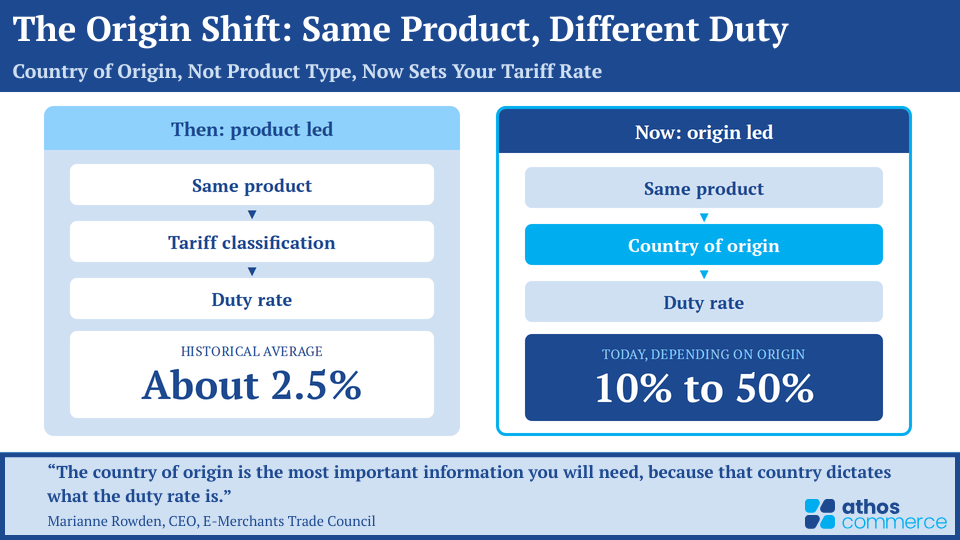
Tariffs used to follow the product. You classified an item, the classification set the duty rate, and the rate held steady. That relationship has broken down. Rates now vary heavily by country of origin, even when the product itself never changes. Duties averaged about 2.5 percent in 2024. By January 2026 the average had climbed to roughly 9.9 percent, with individual country rates ranging from near zero to almost 47 percent.
“We come from a world where the product dictates the tariff classification and the tariff classification dictates the duty rate. That’s not exactly true anymore… the country of origin is the most important information you will need because that country dictates what the duty rate is.”
Marianne Rowden, CEO, E-Merchants Trade Council
What non-tariff barriers should ecommerce sellers watch?
Import duties are only part of the picture. Regulatory compliance for international sales also involves rules that never appear on a rate schedule.
- Licensing and permits: Some product categories require agency approval before they can enter a new market at all.
- Prohibited and restricted goods: Every destination maintains its own list of items that cannot be imported.
- Quotas and standards: Volume caps and product standards can block a shipment even when duties are paid correctly.
- Inspection requirements: Goods flagged for inspection sit at the border, which extends delivery times and frustrates international buyers.
How Do Tariffs Affect Sourcing, Selling, and Shipping?
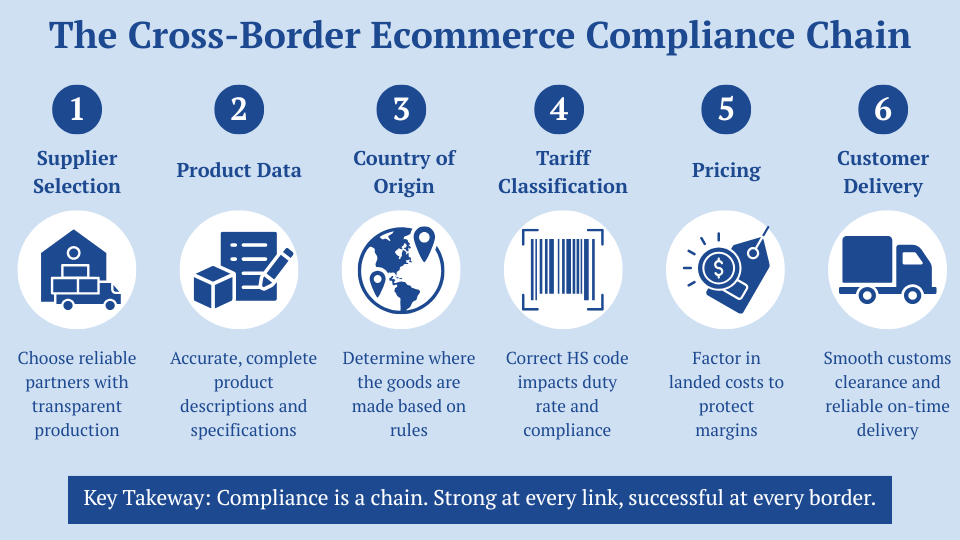
Cross-border trade decisions connect. A supplier choice made for cost reasons can create a customs compliance problem months later. Marianne Rowden and Karen Kelly of the E-Merchants Trade Council outlined three areas where that connection shows up most clearly.
What should you look for in sourcing partners?
Choose vendors who supply accurate, complete product descriptions. That data drives customs clearance and feeds your product listings across channels. Ask for visibility into the full production process, especially when manufacturing spans multiple countries, so you can judge tariff exposure before an order ships.
Watch for sourcing red flags. Vendors who relabel goods in third countries or use double invoicing to misstate value expose you to serious penalties. Even legal methods like first sale valuation and transfer pricing carry audit risk and belong with trade specialists rather than your buying team.
How do selling practices create compliance risk?
Quoting international customers without factoring in duty rates erodes margin quickly. Build landed cost into pricing from the start. Product descriptions need to be accurate and complete, so they satisfy customs regulations and harmonization code requirements.
Know your customer as well. Where a buyer sits and whether you are permitted to sell to them both matter. Marketing claims deserve review too. A “Made in the USA” label may violate regulations when only final assembly happens domestically.
How can you control international shipping costs?
Shipping decisions carry both cost and compliance consequences. Merchants selling into the United States should note that low-value exemptions no longer apply. U.S. Customs and Border Protection suspended the de minimis exemption indefinitely in June 2026, so shipments valued at $800 or less now require formal or informal entry and payment of applicable customs duties.
| Shipping factor | What it affects | What to do |
| Dimensional weight | Shipping cost per parcel | Audit packaging sizes with your logistics provider |
| INCOTERMS | Who carries risk and cost at each stage | Define terms in writing before shipping |
| Country of origin declarations | Duty rate and audit exposure | Document origin at the SKU level |
| Destination import rules | Clearance speed and delivery times | Review rules per market before launch |
Misstating origin or undervaluing goods invites audits and steep penalties. Foreign Trade Zones can defer statutory duties under a non-privileged status, though reciprocal tariffs require privileged status instead.
“Flexibility equals resilience… No matter what the government does, we have enough flexibility built into our commercial relationships and logistics and trade that we can absorb that variation in a way that we didn’t have in the past.”
Karen Kelly, Chair, E-Merchants Trade Council
How Can Smarter Merchandising Reduce Cross-Border Trade Risk?
Tariffs, regulations, and geopolitical shifts can change your margins overnight. That unpredictability raises hard questions. What can you afford to sell? Where can you ship it? What price works in each international market?
Ecommerce sellers are better positioned to answer those questions than traditional retailers. A digital catalog can be adjusted in minutes. The opportunity lies in using product discovery tools to build flexibility into how your online store operates.
What can adaptive product discovery do?
- Localize pricing instantly: Update prices for one region to reflect new import duties without touching global pricing.
- Filter or promote by region: Show products that meet local regulations and hide the ones that do not.
- Build segmented catalogs: Give shoppers in European markets a product set that is available and competitive there.
- Tag products by origin: Group items by country so you can respond to a rate change across an entire product set at once.
“Trade disruption isn’t something we can control. But our response to it can be, and the tools exist. If you’re already digital, you’re already in a much better position than someone who has to manage physical stores and inventory.”
Michael Longauer, Senior Director, Athos Commerce
Consider a practical example. New duties raise your cost on a product line in the European Union. With geo-based merchandising rules, you update pricing for that region alone. If the product becomes unprofitable or non-compliant there, you hide it in that market with a single click while it keeps selling everywhere else.
Athos Commerce: Your Partner in Cross-Border Ecommerce Growth
Trade disruption sits outside your control. Your response does not. Merchants who tag products by region, adjust pricing per market, and keep product data accurate across every channel absorb policy changes that stall their competitors.
Athos Commerce brings onsite search, personalization, merchandising, and product feed management together in one platform built for growing ecommerce brands. Merchandising rules let you control pricing and product visibility by region. Feed management validates and distributes accurate product data across marketplaces, social channels, and AI shopping platforms, which supports both customs compliance and discoverability in every market you sell to.
Global trade will keep moving. Your online sales strategy can move with it. See how Athos Commerce helps retailers turn trade disruption into competitive advantage, and request a demo today.
Frequently Asked Questions
What is the biggest cross-border ecommerce compliance mistake?
Treating country of origin as a shipping detail rather than a data point. Origin now drives the duty rate, so it belongs in your product data alongside price and inventory.
Do small businesses need a third-party logistics partner?
Most benefit from one. A third-party logistics provider handles cross-border fulfillment, customs paperwork, and returns in markets where you have no physical presence.
How does local currency affect cross-border sales?
Shoppers convert at higher rates when they see prices in their own currency at checkout. Payment service providers and financial institutions supporting local methods reduce abandoned carts on cross-border purchases.
Where should international expansion start?
Start with market research. Look at existing traffic, organic demand, and social media engagement by country, then pick one market and get the supply chain right before adding a second.