







How intelligent automation scales product placement without losing control.
Every season, merchandising teams are asked to do more. Product catalogs grow, new channels open, and peak-trading windows compress. Yet, the tools most teams rely on to decide what shoppers see were built for a smaller, slower business. Merchandisers hand-rank products, maintain rules in spreadsheets, and tag items so campaigns behave as intended. That work is skilled and drives real revenue but maxes out. Manual product placement does not scale with the size of a modern product catalog, and the ceiling has nothing to do with how good the team is. McKinsey’s December 2025 Global Merchant Survey found that merchants still spend about 40 percent of their time on low-value tasks such as consolidating data and building reports in spreadsheets.1 For most retailers, the question is how to move from manual control to intelligent automation without losing the judgment that makes merchandising work.
The three stages of merchandising maturity
Merchandising is moving along a predictable maturity curve. The path runs from manual control, to AI-assisted merchandising, and then to AI-executed merchandising.
In the manual stage, people make every product placement decision and encode it by hand. Rules are fixed, tagging is manual, and the quality of the result depends on how complete the underlying product data is. In the AI-assisted stage, merchandisers still set strategy, but AI assists with most of the execution. It ranks and groups products using signals a person could never maintain at catalog scale, and it recommends actions the merchandiser approves or overrides. In the AI-executed stage, the system adapts product placement on its own, learning from performance and shopper behavior, while merchandisers supervise and set the overall strategy and goals.
Most teams sit in the first stage and assume the third means handing the store to a machine, when in fact each stage keeps the merchandiser in charge of strategy and gives more of the repetitive execution to software. McKinsey describes the same progression, from manual work to AI-assisted to agentic merchandising, and estimates that automating consolidation, forecasting, and planning can free roughly 40 percent of a merchant’s capacity.2
Stage one: manual control and where it hits a wall
Manual merchandising is where nearly every team starts, and for a long time, it works. A merchandiser knows the catalog, pins the hero products, orders a category to lead with best sellers, and writes rules to promote or bury items based on inventory or margin. However, the approach breaks down for structural reasons.
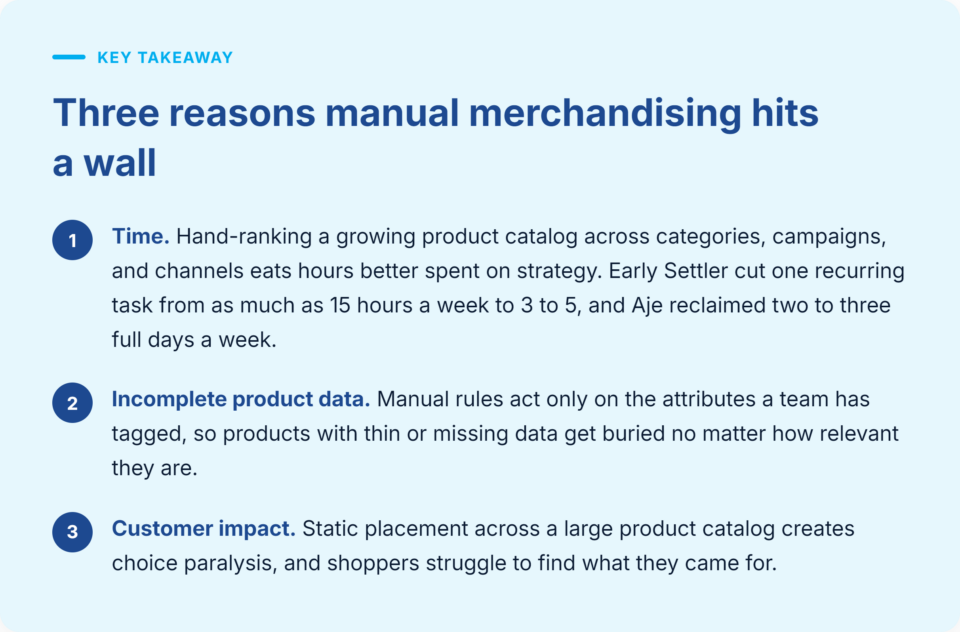
The first problem is time. Manually ranking a growing product catalog across categories, campaigns, and channels consumes hours that merchandisers would rather spend on strategy. Retailers that automated the repetitive parts have measured the difference. Early Settler cut a recurring merchandising task from as much as 15 hours a week to 3 to 5 hours through automated rules, and Aje reclaimed two to three full days a week.3 The second problem is incomplete product data. Manual rules can only act on the attributes a team has managed to tag, so products with thin or missing data get buried, no matter how relevant they are to a shopper. The third problem lands on the customer. When placement is static, and the product catalog is large, shoppers face choice paralysis and struggle to find what they came for. Furniturebox ran into this across more than nineteen hundred SKUs before it changed approach.4
Stage two: AI-assisted merchandising keeps control with the team
The step up the maturity curve is the one that worries merchandisers most, and it should worry them least. AI-assisted merchandising leaves the merchandiser’s judgment in place and removes the manual tedium between the decision and the result.
At this stage, the merchandiser still sets the strategy, which products to feature, which to hold back, and what a category should accomplish. AI carries the execution at a scale a person cannot match. It can boost or demote products using attributes, visual similarity, and generative signals, so a placement rule works even when a product was never explicitly tagged. It can group products the way shoppers browse, by style or intent rather than by how the data is structured. And it can test those decisions with A/B experiments, so the team knows which changes earned the lift instead of guessing.
Furniturebox is a great example of this in practice. The retailer applied tiered logic to prioritize in-stock, high-performing products, pinned key items to mimic premium placements, and ran A/B tests on category sorting. Conversion rose 15 percent, and daily revenue climbed 20 to 25 percent during peak trading.5 None of that required giving up control. It required handing the repetitive work to software and keeping the strategy with the people who understand the business.
This stage is also where much of the industry’s disappointment lives. In the McKinsey survey, 71 percent of merchants said AI merchandising tools had produced limited or no impact so far.6 The reason is rarely the model. The tools sit on top of fragmented systems and product data too messy to act on, a problem the next stage cannot ignore.
Stage three: AI-executed merchandising and agentic readiness
In the AI-executed stage, the system does more than recommend. It adapts product placement on its own, learning from performance and shopper behavior, and the merchandiser moves from operator to editor. Self-learning merchandising proposes and adjusts promotions based on what has worked, and the team supervises the outcomes and sets the guardrails rather than touching every rule.
This is also where merchandising meets agentic commerce. Shoppers are beginning to discover and buy through AI assistants and agents, not only through a brand’s own site. When an agent evaluates products on a shopper’s behalf, it relies on the same product data and merchandising logic that power the onsite experience. If that logic runs on current, shared product data, the brand shows up correctly wherever the shopper is. If it runs on siloed data updated by hand, the brand goes missing in exactly the places shoppers are moving toward.
McKinsey found that 61 percent of merchants say they are not prepared to scale AI across merchandising, and the barrier is usually fragmented systems and data that is too messy to use.7 Reaching the AI-executed stage is less about buying a smarter model and more about giving it one clean, connected source of product data to act on. The teams that get there connect the process first and then let automation run it.
How to move up the curve
Moving from manual merchandising to intelligent automation is a sequence, not a single purchase. Three steps make the path concrete.
- Find where manual effort concentrates: The tasks that eat the most hours and return the least strategic value, usually reporting, re-ranking categories, and reconciling product data across systems, are the first to automate.
- Connect your product data before you automate it: AI-executed merchandising only works when search, merchandising, and product feed data draw on one foundation, so the same signals drive what a shopper sees onsite and what an agent sees offsite. This is the step most teams skip, and it is why so many AI merchandising projects stall. An all-in-one platform that unifies search, personalization, merchandising, and product feed management gives automation a single, current source of product data to act on, which is what turns recommendations into reliable execution.
- Pilot AI-assisted merchandising against a control: Pick one category or campaign, let the system boost, bury, and group products, and measure it with an A/B test against your manual approach. Proving the lift on a small scale builds the confidence to hand over more.
Intelligent discovery that scales with your catalog
Automating merchandising frees the team to spend its time on strategy instead of maintenance. Judgment about what a brand should promote and how it presents its products will always belong to people. What automation absorbs is the labor of applying that judgment across a large product catalog and every channel a shopper might use. Retailers that make the move reclaim their merchandisers’ time, help shoppers find the right products faster, and prepare for a market where discovery increasingly happens through AI. That is intelligent discovery, and it scales with the product catalog instead of straining against it.
Frequently asked questions
What is intelligent merchandising automation?
Intelligent merchandising automation is the use of AI to execute product placement decisions that merchandising teams once made and maintained by hand. Instead of hand-ranking a product catalog and editing rules in spreadsheets, merchandisers set the strategy and let AI rank, group, boost, and bury products at catalog scale. The merchandiser keeps control of what a brand promotes, while software handles the repetitive work of applying that judgment across every category, campaign, and channel.
How is AI-assisted merchandising different from AI-executed merchandising?
AI-assisted merchandising keeps a person in the decision. The merchandiser sets strategy and approves or overrides AI recommendations, such as which products to boost or how to group a category. AI-executed merchandising lets the system adapt product placement on its own, learning from performance and shopper behavior, while the merchandiser supervises outcomes and sets guardrails. The difference is whether AI proposes a decision for a human to confirm, or makes and adjusts it within limits the team defines.
Does automating merchandising mean losing control over product placement?
No. Automation removes the manual labor between a merchandising decision and its result, not the decision itself. Merchandisers still choose which products to feature, which to hold back, and what each category should accomplish. AI applies those choices across a large product catalog and tests them with A/B experiments, so the team can prove which changes earned the lift. Control moves from editing individual rules to setting strategy and supervising outcomes.
Why do so many AI merchandising tools fail to deliver results?
Most AI merchandising tools underperform because they sit on top of fragmented systems and product data too messy to act on. In McKinsey’s December 2025 Global Merchant Survey, 71 percent of merchants said AI merchandising tools had produced limited or no impact so far, and 61 percent said their organization was not prepared to scale AI across merchandising. The barrier is rarely the model. It is the disconnected, low-quality product data the model has to work with.
Where should a retail team start with merchandising automation?
Start by finding where manual effort concentrates, usually reporting, re-ranking categories, and reconciling product data across systems. Connect that product data on one foundation before automating it, so search, merchandising, and product feed data share a single source. Then pilot AI-assisted merchandising on one category or campaign and measure it against your current manual approach with an A/B test. Proving the lift on a small scale builds the confidence to automate more.
Sources & Further Reading
- McKinsey & Company. “Merchants Unleashed: How Agentic AI Transforms Retail Merchandising.” McKinsey & Company, December 2025. https://www.mckinsey.com/industries/retail/our-insights/merchants-unleashed-how-agentic-ai-transforms-retail-merchandising.
- McKinsey & Company. “Merchants Unleashed: How Agentic AI Transforms Retail Merchandising.” McKinsey & Company, December 2025. https://www.mckinsey.com/industries/retail/our-insights/merchants-unleashed-how-agentic-ai-transforms-retail-merchandising.
- Athos Commerce. “Ecommerce Success Story: Early Settler Drives Omnichannel Growth.” Athos Commerce case study. https://athoscommerce.com/case-studies/early-settler/. And Athos Commerce. “Aje Serves Up Personalized Ecommerce Shopping Experiences.” Athos Commerce case study. https://athoscommerce.com/case-studies/aje/.
- Athos Commerce. “Boosting Conversions Through Strategic Merchandising and Search Optimization at Furniturebox.” Athos Commerce case study, 2025. https://athoscommerce.com/case-studies/furnitureboxuk/.
- Athos Commerce. “Boosting Conversions Through Strategic Merchandising and Search Optimization at Furniturebox.” Athos Commerce case study, 2025. https://athoscommerce.com/case-studies/furnitureboxuk/.
- McKinsey & Company. “Merchants Unleashed: How Agentic AI Transforms Retail Merchandising.” McKinsey & Company, December 2025. https://www.mckinsey.com/industries/retail/our-insights/merchants-unleashed-how-agentic-ai-transforms-retail-merchandising.
- McKinsey & Company. “Merchants Unleashed: How Agentic AI Transforms Retail Merchandising.” McKinsey & Company, December 2025. https://www.mckinsey.com/industries/retail/our-insights/merchants-unleashed-how-agentic-ai-transforms-retail-merchandising.