














A 100-meter sprinter and a marathon runner are both elite athletes, but they train very differently. Sprinters build muscle for one explosive effort that’s over in about ten seconds. Marathon runners tend to look slighter. The latter have spent months building the stamina to keep a steady speed for hours and still have something left for the final few kilometers.
For a long time, an online retailer’s Black Friday strategy rewarded the sprint. It was one day, then one weekend, and the brand with the deepest discount or highest advertising highest budget usually drew the most attention. That approach still has its place. However, the start and finish lines of the race have changed.
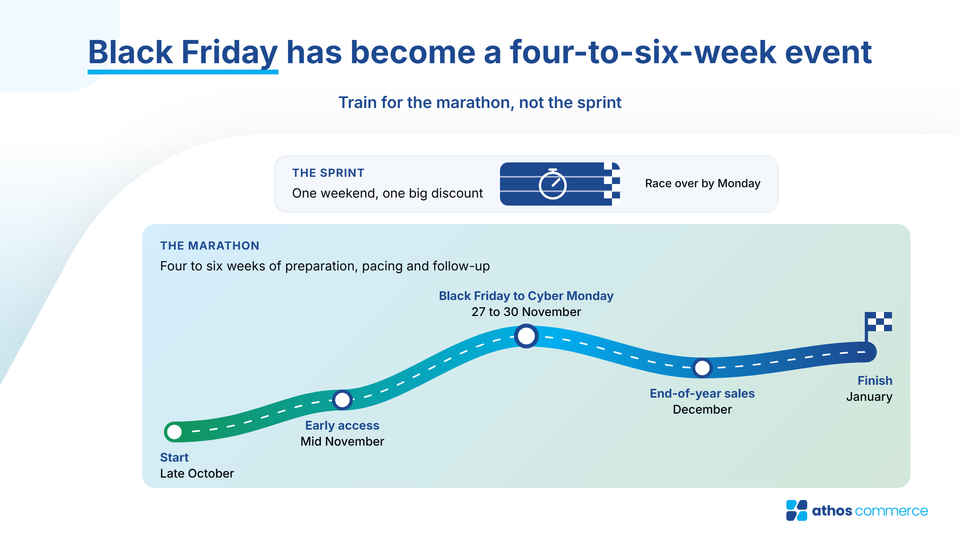
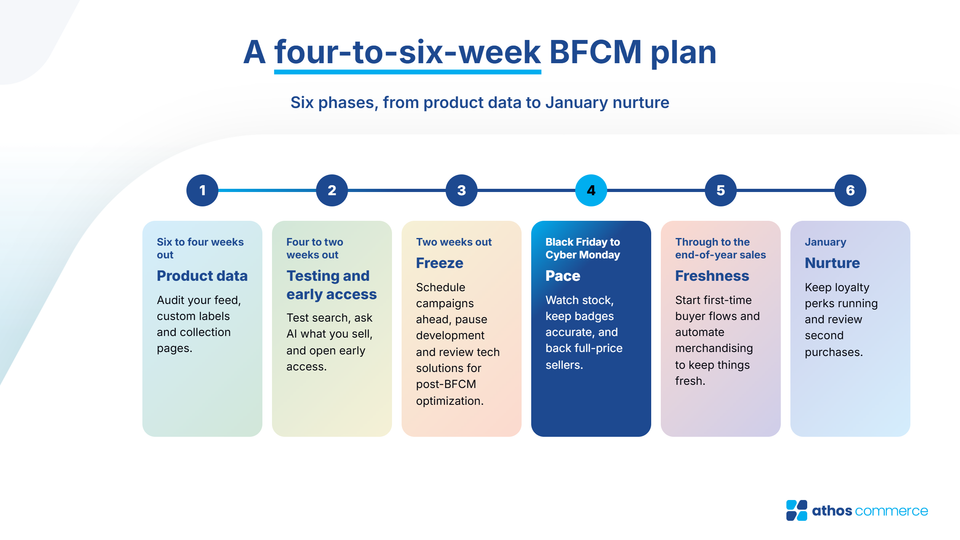
Some brands now go on sale in late October, while others run well past Cyber Monday, continuing straight into the Christmas and end-of-year sales. For many retailers, the real Black Friday Cyber Monday (BFCM) period now lasts somewhere between four and six weeks. Shelley Yung, Performance Marketing Manager at fashion retailer DECJUBA, described on our Ecommerce Pulse webinar how the length of a sale dramatically changes the setup, “It’s important to give customers a reason to re-engage with the sale. So, of you’re running a blanket 20% off and it goes for four weeks or longer, how are you refreshing that message. How are you refreshing that pace?” She details tactics such as weekly refreshes, fortnightly product drops, adding new products into the sale mix, adapting creative and messaging mid-sale according to category performance, and using product data feed strategies such as labelling to prioritize newer products across ad channels.
A six-week event calls for a different kind of fitness. Training for it starts with your product data, well before the start line. From there, it’s about pacing your on-site experience across the whole peak period and bringing discount shoppers back to your site at full price.
The Black Friday Boost
The biggest days still matter most. Adobe expects US online holiday spending to reach a record $275.1 billion between 1 November and 31 December 2026, up 6.7% year over year.¹ Cyber Week, from Thanksgiving to Cyber Monday, is forecast to account for $47.5 billion of that, with Cyber Monday (30 November) at $15.1 billion and Black Friday (27 November) at $12.9 billion. Those five days alone make up 17.3% of the season’s online spend.
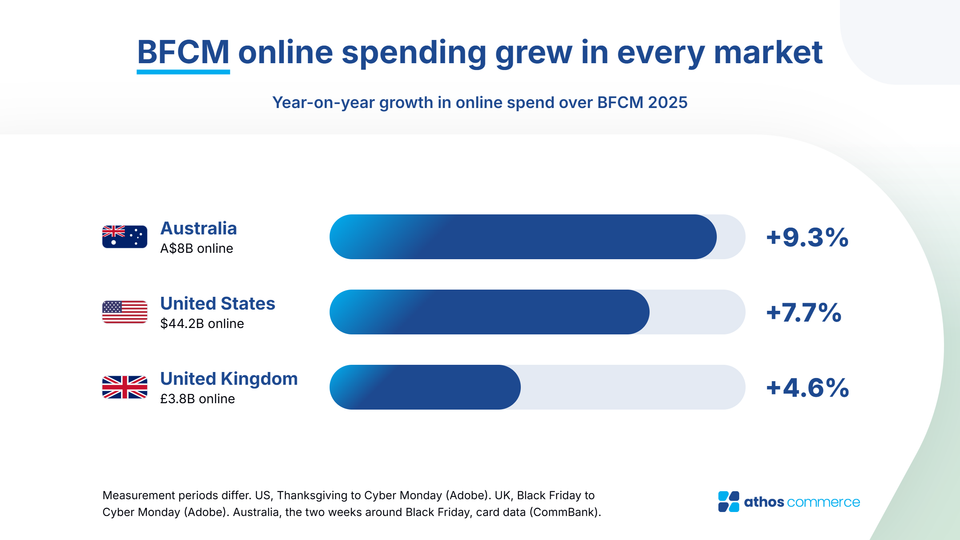
What has changed is everything around those days. Adobe also expects US retailers to offer discounts of up to 14% in early November and up to 21% in the days before Thanksgiving, so shoppers are seeing deals for weeks before the main event.¹ In Australia, CommBank card data for the two weeks around Black Friday 2025 showed A$23.8 billion in spending, with online up 9.3% to A$8 billion and driving almost all of the growth.² Spending in the week before Black Friday was up 5.1% on the previous year, slightly ahead of the 4.1% rise in Black Friday week itself. The Australian Retailers Association had forecast A$6.8 billion for the Black Friday to Cyber Monday weekend alone.³
In the UK, shoppers spent £3.8 billion online from Black Friday to Cyber Monday 2025, up 4.6% on the year before, according to Adobe.⁴ IMRG’s 2025 Black Friday week data points to a shopper who browses early and buys late. Orders on the Thursday before Black Friday fell 6.8% year on year even as traffic rose, while the strongest order growth came on the Tuesday of Black Friday week (up 7.8%), and the highest average basket of the week (£149) landed on Cyber Monday.⁵
Shoppers are waiting on purpose. Sarah, who runs ecommerce at homewares brand Kip&Co, sees it in the questions her customer care team fields and in how people move through the site. “They’re comparing a lot more now, and they’re really waiting for the right moment,” she said at AI in Ecommerce, a recent Athos Commerce masterclass event.⁶ “It’s considered. There’s a lot of research, especially when they know there’s going to be a big sale period.”
Lawrence Hitches, Chief of Staff at StudioHawk, gave a good picture of what that research looks like. He and his wife were buying a walking pad for their home office. He would search Google, look at a couple of options and buy. She was working through ChatGPT, Claude and Gemini, and he expected her to decide by Sunday afternoon once she’d compared size, weight and price against the space in their small office. Shoppers like her arrive at your site with a shortlist and a price in mind, and they’re comparing you against everyone else running a sale that week.
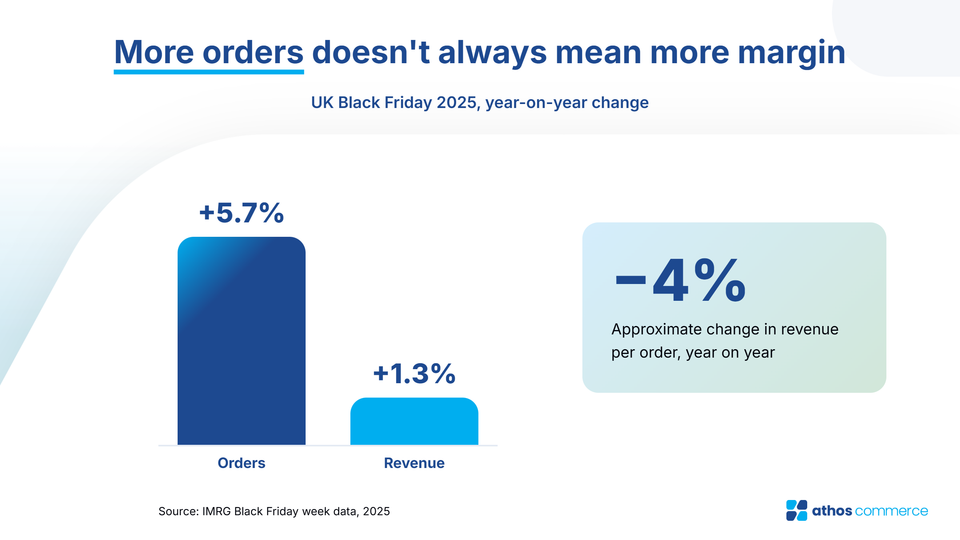
The cost of sprinting often shows up in the margin. IMRG’s figures show UK Black Friday orders up 5.7% in 2025 while revenue grew only 1.3%, which means each order was worth about 4% less than the year before.⁵ Salesforce found that by the end of the 2025 holiday season, 14% of global online purchases made from November to December had already been returned.⁷ Volume alone doesn’t guarantee profit, which is why the brands planning for the longer race give margin as much attention as orders.
Get your product data ready before the start line
Before race day, marathon runners spend months running long, steady distances to build up their fitness. The equivalent for BFCM is your product data. It decides whether your products appear in Google Shopping, Meta and AI answers, and it powers the search, filters and recommendations shoppers use once they reach your site. It’s also the work that’s hardest to rush in the final two weeks.
Give your feed a pre-peak tune-up
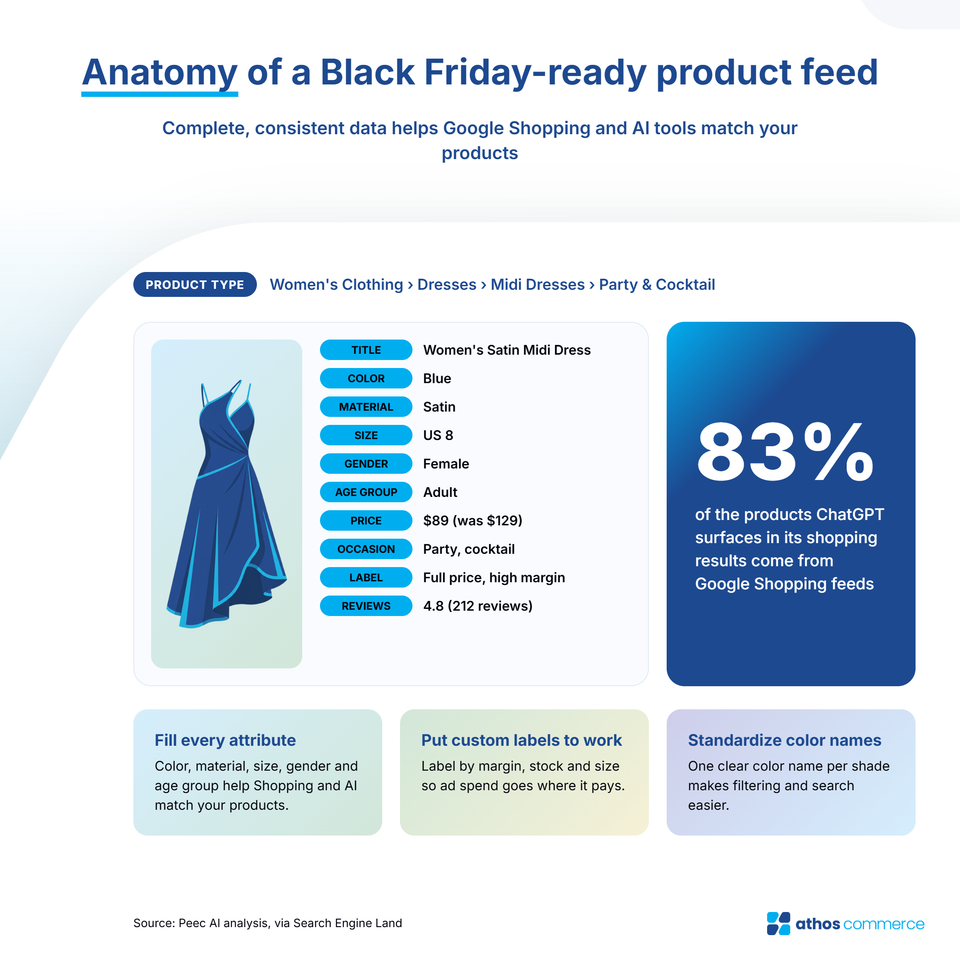
In the product feed audits Athos Commerce carries out with retailers ahead of peak, the biggest opportunities tend to be the same. Many feeds were set up at launch, often before the current team joined, so there’s plenty of room to optimize. When Google product category is left blank, Google guesses, and it tends to guess broadly, which is how a women’s boot ends up in a unisex category. Product type, which can carry up to five levels of detail and is one of the attributes Google leans on most for relevance, often has room for more. Standardizing color names helps too, since a catalog can easily build up 23 names for a single color over time.
The fix is a product type that reads like the way people shop. For a dress, that might be Women’s Clothing > Dresses > Midi Dresses > Party & Cocktail. Ahead of BFCM, you can add seasonal terms such as Black Friday sale or Christmas gift ideas so your products match what people search for when traffic peaks. The language matters more than most teams expect. When Pillow Talk A/B tested adding the word “winter” to its flannelette sheet titles, revenue for those products rose 158%.
If the catalog is large, don’t try to fix it all at once. Start with your top 20% of products by revenue, because that’s where you’ll see movement first. Then set the standard as a rule rather than a manual fix, so next week’s product drop doesn’t undo the work.
Use your feed to protect margin as well as reach
Your feed controls what gets advertised, which makes it one of the most direct levers you have on profit. Google allows up to five custom labels per product, and many feeds have room to use more of them. Labeling products by margin, stock depth, size availability and performance lets you put budget behind full-price, high-margin, in-stock products and automatically pull spend from the ones that shouldn’t attract it, such as items with broken size runs or lines you’ve already discounted heavily for Black Friday.
International fashion brand Outcast used this approach over December and January to cut ad spend by 77% while growing revenue by 25% and conversions by 22%. David Jones found a similar effect with promotions. Adding merchant promotions to its feed lifted click-through rate by 43%, and because the team could see which categories and brands carried healthy margins, it targeted promotions where they made money instead of applying them across the board.
Treat the feed as your AI strategy
AI now sits at the start of many shopping journeys. Adobe recorded a 670% year-over-year jump in AI-referred traffic to US retail sites on Cyber Monday 2025.⁸ It expects AI traffic over the 2026 season to more than double again.¹ Salesforce estimates AI and agents influenced $262 billion of global online holiday sales in 2025, roughly one in every five dollars, and found that shoppers arriving from AI-powered search converted nine times more often than those referred from social media.⁷
Much of what these tools recommend comes from the same structured data you already send to Google. Alex Ross, Senior Business Development Manager at Athos Commerce, has cited research showing that around 83% of the products ChatGPT surfaces in its shopping results come from Google Shopping feeds.⁹
“Your product feed is already your LLM strategy,” Alex said during our From AI Answer to Repeat Buyer: Discovery That Sticks Past Peak webinar. “The brands getting named in AI answers right now are the ones that did their feed properly for Google Shopping, and now they’re seeing that reward come through AI answers too.”
A useful test takes about 30 seconds. Open ChatGPT or Gemini and describe what your customer would want, in their words and without your brand name. In one example Alex demonstrated, a shopper asked Gemini for affordable furniture for a child’s bedroom from an Australian brand. Gemini returned a shortlist, and the shopper then searched for one of those brands on Google and clicked through. That’s worth remembering when you review results after peak, because AI-influenced visits often show up in your reports as branded search. If you’re not in the shortlist, check whether your product data actually contains the attributes the AI needed to name you, such as the occasion, the material or the size.
Build pages you can reuse every year
Dedicated Black Friday collection pages, built around what your customers searched for in previous years, give Google and AI tools a page that matches what shoppers are looking for. Refresh them each year and keep them live after the sale. Take them out of the navigation, but keep them internally linked so they hold on to the authority they’ve built. Kip&Co has put a lot of work into its collection pages and structured data for exactly this reason, and Sarah said that work “means we’re showing up in AI and in Google feeds.”
Charbel Raffoul, Head of SEO Performance at StudioHawk, says the foundations still do most of the work in AI search. That means the content on your product pages and collection pages, and even your delivery, returns and policy pages, because shoppers now ask LLMs how a brand’s returns or delivery work. “What matters more than ever is how the content and what you say about your brand is structured on your website,” he said during our Ecommerce Pulse: From Price Pressures to AI Impact webinar. In practice, that means before and after prices in your HTML, schema markup, discount details that shoppers, Google and AI agents can all read, and pricing and product content that stay consistent across your site and the marketplaces you sell on.
Customer reviews also give LLMs additional context. Emma Coyer, Digital Marketing Director at Outcast, said during our Ahead of the Algorithm: The AI in Ecommerce Masterclass webinar that the team now encourages customers to say why they bought something. A review that says “I bought this dress for my birthday” gives LLMs context that “I love this dress” doesn’t, and that helps the product show up when someone asks for a birthday outfit.
None of this replaces the basics. Lawrence works to an 80/20 split, with most of the effort going on technical foundations, crawlability and link acquisition before the more experimental work on YouTube, Reddit and other sources LLMs cite.
Pace yourself on-site across the whole event
Experienced marathon runners don’t start the race at full speed, because they’d run out of energy long before the finish. Over a long BFCM period, pacing means an on-site experience that converts in week one as well as it does in week five.
Expect shoppers to skip your homepage
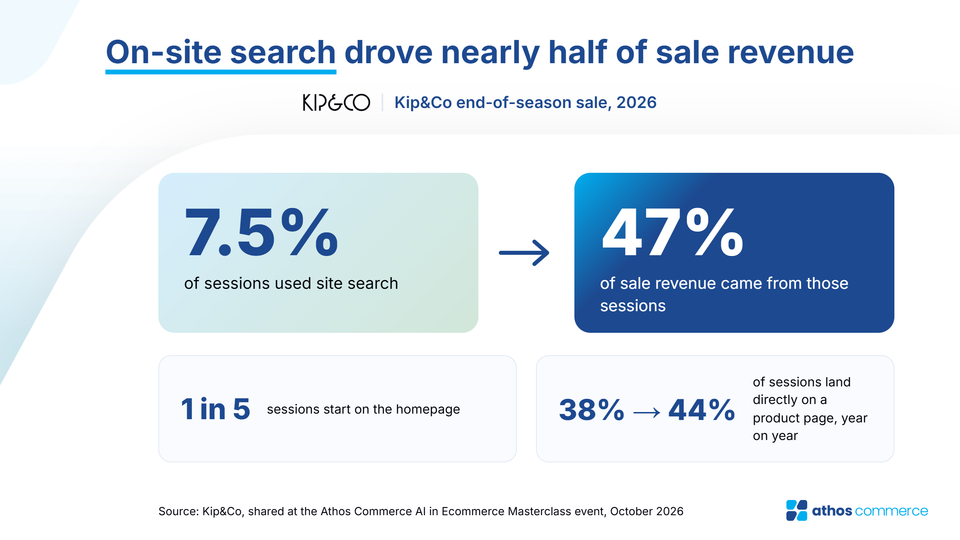
Sarah shared some useful numbers from Kip&Co’s own data at the same event. Only one in five sessions on the Kip&Co site start on the homepage, despite the effort the team puts into it. Around three quarters land straight on a product or collection page, arriving from social, SEO and AI tools, and the share landing directly on a product page has grown from 38% to 44% in a year.
That changes where your selling happens. A shopper who lands on a product page has skipped your homepage, your brand story and the rest of your range. Product recommendations have to show them what else you sell, both similar items in case this one isn’t right and complementary items that grow the order. Kip&Co uses styling advice, recently viewed products and cross-category recommendations on its product pages. Recently viewed is easy to overlook, but it converts well during a sale, when shoppers are jumping between tabs and sites and want to get back to what they were looking at.
Make search do more of the work
During its end-of-season sale earlier this year, 7.5% of Kip&Co’s sessions used site search, and those sessions generated 47% of revenue. “It’s that customer who knows what they want because they’ve seen it,” Sarah said, “and they just want to come and find it and convert.”
That shopper is easy to lose. If they’ve seen a lilac ruffle quilt cover on TikTok and your catalog calls it purple, a zero-results page sends them to a competitor. Keep the search bar open, high-contrast and visible as shoppers scroll on mobile. Make sure synonyms and color groupings are in place, and test it yourself with a use case rather than a product name, such as “yellow mini dress for a party”. Product descriptions should describe the item itself. A description that says “pair with white jeans” can put a yellow top in the results when someone searches for white jeans.
For peak, Sarah’s team is making search, filters and badges sale-ready. That means showing the discount at a category level, adding an on sale and not on sale filter, and setting everything to update automatically. Badges need the same care. A “selling fast” badge on a product with 400 units left is a quick way to lose a shopper’s trust in a week when they’re comparing you against every other sale.
Keep full-price and sale shoppers segmented
You’ll attract deal hunters over BFCM, and that’s expected. The real opportunity is to give them a great sale experience while keeping your full-price range front and center for everyone else. Ksubi, speaking on our Ecommerce Pulse panel in July, keeps its full-price and markdown journeys separate during sales. Full-price shoppers see full-price products, recommendations are separated at product, cart and checkout level, and the team deliberately avoids leading with its deepest markdowns, both to protect margin and to avoid a wall of sale tags that sends shoppers away.
Kip&Co has found the same thing in its testing. Full-price customers and sale customers respond to completely different merchandising logic, and some categories perform better with personalization than with the team’s own rules. The team has built a new merchandising strategy for Black Friday and plans to carry it through to the end-of-year sales.
Merchandising rules can also push the products you most want to sell without a discount. Rules that weigh margin, full-price status, stock depth and size availability give your best stock the most visible positions in search and on collection pages, and hide products with broken size runs. Angus Growney, Performance Manager at BARED Footwear, uses on-site data to surface products with lower return rates, which matters in the US, where return rates are much higher than in BARED’s other markets. Fewer returns improve the experience for the customer and save the business money.
Keep a six-week sale feeling fresh
Refreshing a sale through all six weeks gives shoppers a reason to keep coming back. Shelley’s answer is to manage pace, newness and message across a long sale. That means weekly refreshes and new products added to the sale mix, shifting creative toward whichever category takes off, and messaging that goes further than “20% off”. New products are hard to push through Google Ads because they have no performance history, so the team uses feed labels to bring them forward. SUBI reviews markdown depth week by week rather than setting it once.
Grow average order value with a plan
Peak traffic is expensive traffic, so set an AOV goal before it arrives. That might be a $10 lift or moving from two items per cart to 2.3, and from there you can work backwards. Check whether your free shipping threshold actually nudges order value up or just gives margin away.
Then find your low-price, high-margin add-ons and place them on the product page, in the cart and after checkout. The checkout aisle at a discount store and the minis at Sephora are there for the same reason. For Kip&Co, gifting is the opportunity. Candles, eye masks and slippers are easy to add to a basket. “Everyone wants some $40 slippers,” Sarah said. Bundles and multi-buy offers work too, as long as shoppers can see them on product cards and recommendations at the moment they decide.
Lock the site down before the start
The last piece of advice Sarah gave was the simplest. Kip&Co has already paused web development for peak. “We learned from our mistakes,” she said. “Something had to be done during peak once, and it was a nightmare.” Some things are out of your control, as anyone who traded through last year’s AWS outage will remember, but a freeze stops you from adding risk of your own. Schedule banners, sorting changes and campaign switches ahead of time, and use tools your team can change without a developer.
Kip&Co has also worked on what happens at checkout. After this year’s US import changes, the team made sure international shoppers pay everything up front, so there are no surprise charges when an order arrives. It has also switched on click and collect and ship from store since opening its first store, which puts more stock within reach of online shoppers.
The final kilometers: turning sale shoppers into full-price customers
A marathon is decided late in the race, and BFCM is the same. A discount can bring in the first order. What you do after it is what turns a sale shopper into a customer who comes back in February at full price.
Score your customers before the traffic arrives
RFM modeling scores every customer on recency, frequency and monetary value, so you can see who’s loyal, who’s drifting, who’s inactive and who has high potential before the busiest weeks of the year. If you already use RFM, recalibrate the thresholds for peak. A $50 order in February and a $50 order on Black Friday don’t tell you the same thing about a customer.
Give lapsed high-value customers early access
Take your high-spending customers who have started to lapse, add predicted lifetime value, and invite them in early with exclusive access. Many brands now open early access two to four weeks before Black Friday, so reach this group before the general Black Friday emails start, while their inbox is quieter and they’re cheaper to bring back.
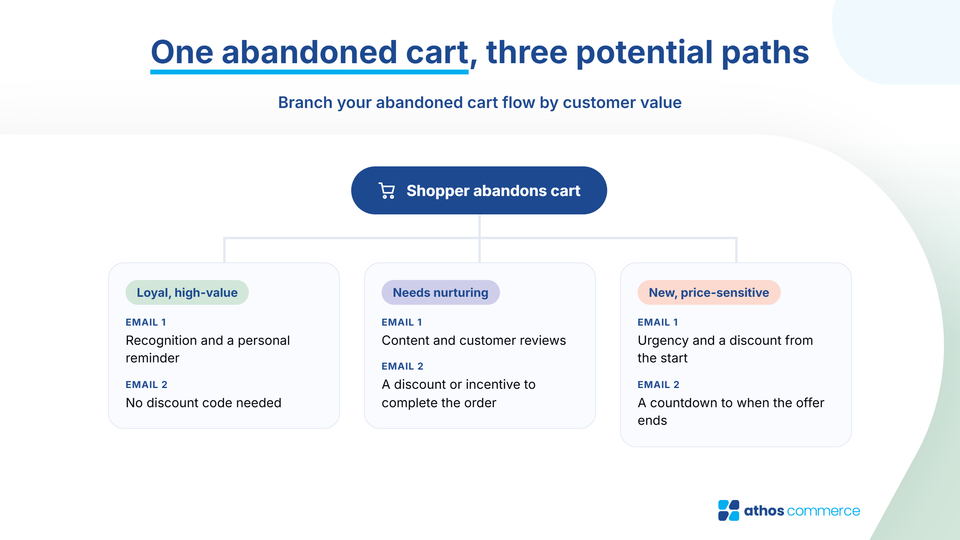
Branch your abandoned cart flow by customer value
Branching your abandoned cart sequence by customer value gives each shopper the message most likely to bring them back. Loyal, high-value customers usually don’t need a discount code to return. They want to feel recognized. Shoppers who need nurturing get content and reviews first, with any incentive saved for the second email. New, price-sensitive shoppers get urgency and the discount from the first touch. It’s the same trigger, but each group gets a different reason to come back.
Follow up first-time buyers deliberately
Customers who bought on discount with no history with your brand need their own post-purchase sequence. Lead with a cross-sell or category nudge so they see more of your range, holding the second-purchase incentive for a later email, and inviting them into your loyalty or VIP program. Start these flows in the weeks straight after BFCM, then keep nurturing campaigns and loyalty perks running through January. Set up a reconversion segment to run as soon as the sale ends, and track how customers move between segments over the following weeks.
BARED Footwear has found that the move from a first pair to a second matters more than any later step. Using its customer data, the team learned that once customers reach four or more pairs, loyalty and lifetime value rise sharply, but the jump from one to two is where it now focuses. As Angus put it during our Ahead of the Algorithm: The AI in Ecommerce Masterclass webinar, the brands pulling ahead are “thinking about what’s driving that sale in four or five weeks’ time.”
The upside of AI-led discovery is that the purchase still tends to happen on your site. Alex pointed to eMarketer research showing 69% of shoppers still complete the purchase on the retailer’s own site rather than inside the AI platform. Every one of those visits is a chance to collect the data and build the relationship that brings them back directly next time.
Plan your next improvements while the traffic is still coming in
BFCM brings a surge of new shoppers to your site, and many of them will return in the weeks that follow. If you’re weighing up product feed optimization to keep your products and brand visible after the sale, or on-site improvements to keep converting those new shoppers, now is a good time to start that conversation with your ecommerce technology partners. Planning and building over the coming weeks means the work is ready to make the most of post-sale traffic, lifting conversion and AOV well into the new year.
A four-to-six-week Black Friday strategy
If you’re reading this with four weeks to go, focus on your top 20% of products and your highest-traffic search terms first. The rest of the plan still applies.
Ask most marathon runners and they’ll tell you the race was decided by the months of training they put in before they reached the start line. BFCM works much the same way. The discount still matters, but the brands that reach January with healthy margins, and with customers ready to buy again at full price, usually did the unglamorous preparation first and kept enough in reserve to finish well.
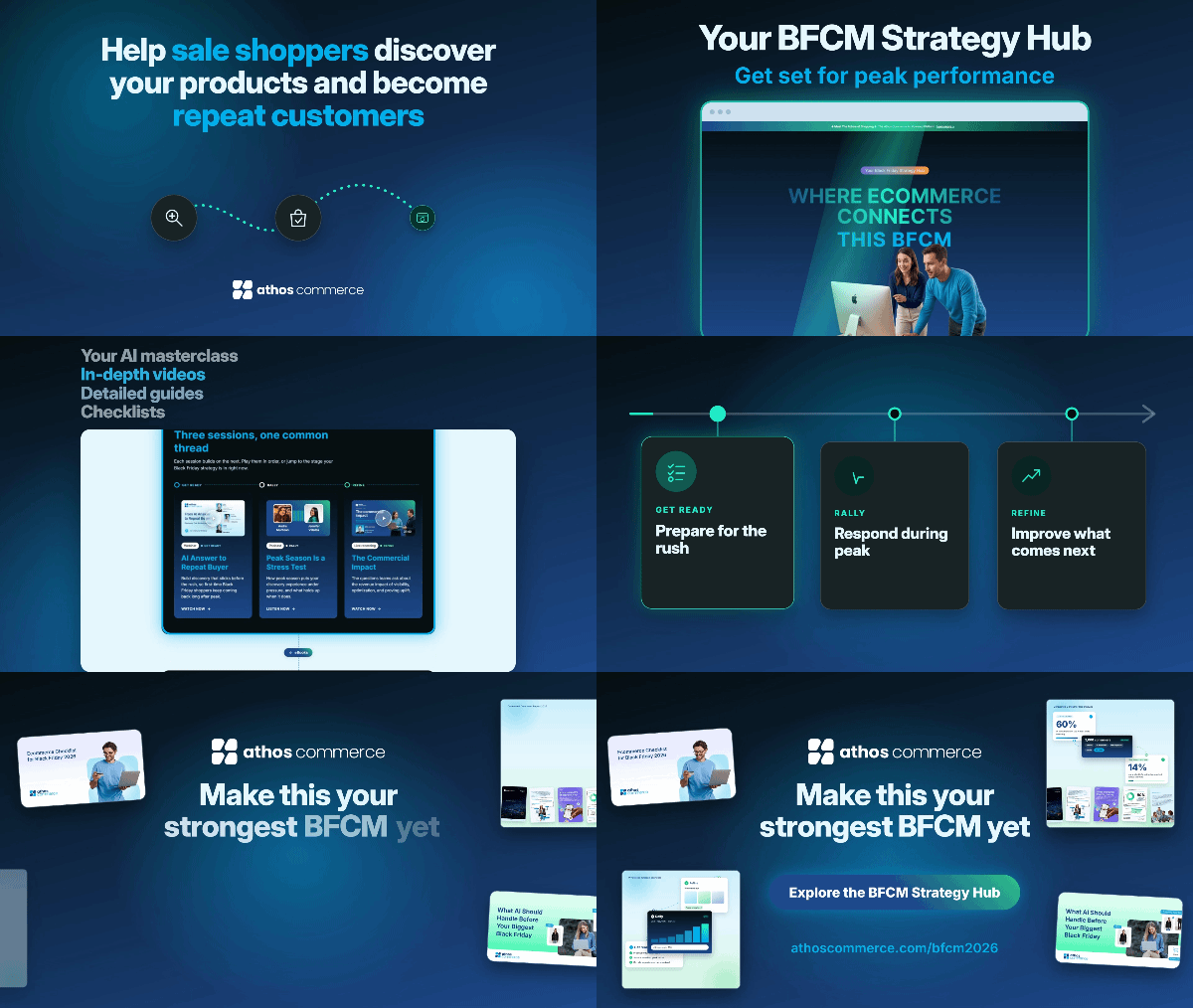
Planning your peak season? Visit our Ecommerce Black Friday Strategy Hub 2026 for more ways to help sale shoppers discover your products and come back as repeat customers.
How Athos Commerce helps you go the distance
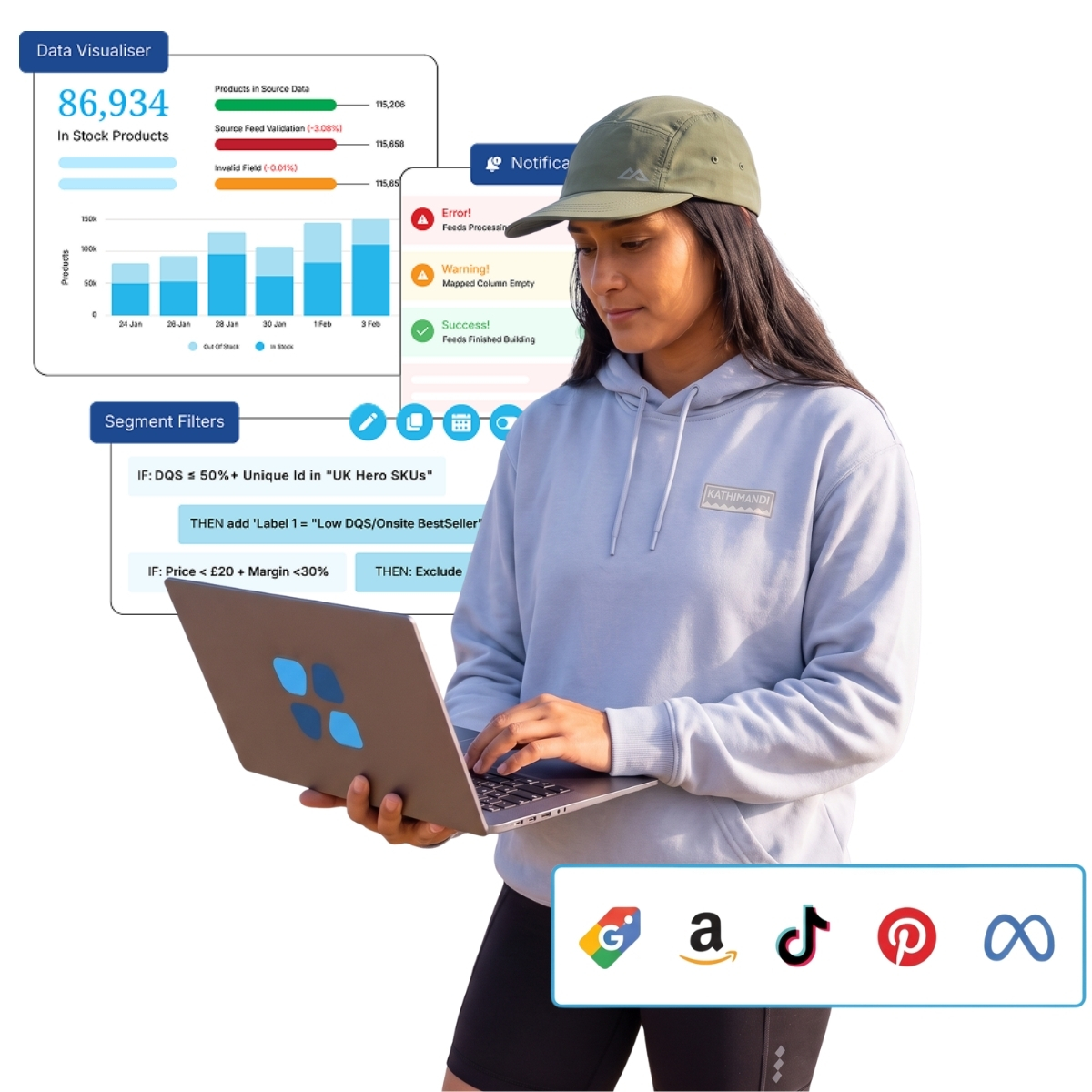
Athos Commerce brings product feed management, site search, merchandising and personalization together in one platform, so the same product data powers how shoppers find you off-site and what they see once they arrive. Automated feed rules and custom labels keep your catalog consistent across Google, Meta, marketplaces and AI platforms such as ChatGPT and Gemini. On-site, AI-powered search, rules-based merchandising and real-time personalization help you convert peak traffic while protecting margin, and your team can schedule and change campaigns without waiting on developers.
Want to know where you stand before peak? Get your complimentary audit of your feed or an on-site experience review.
Frequently asked questions
When does Black Friday start for retailers now?
For many retailers, Black Friday is no longer a single weekend. Some brands launch offers in late October and others run through to Christmas and the end-of-year sales, so the BFCM period often lasts four to six weeks. Black Friday falls on 27 November and Cyber Monday on 30 November in 2026.
How do you protect margin during Black Friday?
Use custom labels in your product feed to focus ad spend on full-price, high-margin, in-stock products, and exclude broken size runs and heavily discounted lines. On-site, use merchandising rules to give your best stock the most visible positions and keep full-price and sale journeys separate.
How does AI affect Black Friday shopping?
More shopping journeys now start in AI tools such as ChatGPT and Gemini, which draw heavily on product feed data. Complete, consistent product data makes it more likely your products are recommended. Most shoppers still complete the purchase on the retailer’s own site, so the on-site experience still decides the sale.
How do you turn Black Friday shoppers into repeat customers?
Score customers with RFM before peak, branch your abandoned cart and post-purchase flows by customer value, and run a reconversion segment as soon as the sale ends. Focus on getting first-time buyers to a second purchase, ideally at full price.
References
- Adobe: US holiday shopping season to hit record $275.1 billion online (2026 forecast)
- CommBank: Black Friday travel splurge lifts spending to $23.8bn record (2025)
- Inside Retail: ARA predicts Black Friday bonanza for retailers (2025)
- Investing.com (Reuters): UK online Black Friday to Cyber Monday spending rises 4.6%, Adobe data (2025)
- Base: Black Friday 2026, 6 numbers UK sellers need to know (IMRG 2025 data)
- Athos Commerce on LinkedIn: AI in Ecommerce masterclass event (October 2026)
- Salesforce: AI and agents account for $262 billion of 2025 holiday spend
- Adobe: Cyber Monday hits record $14.25 billion in online spending (2025)
- Search Engine Land: ChatGPT sources 83% of its carousel products from Google Shopping (Peec AI analysis)