








Kick Game tripled conversion after filtering finally matched its pricing.
Why size-level price filtering decided the platform choice, and what it unlocked afterward.
Summary
Kick Game sells limited-edition sneakers and streetwear, a category where a single style carries a different price in every size. That is an ordinary fact of the resale and limited-release market and an awkward one for discovery software, because most search and merchandising platforms model price as one value attached to one product. When a shopper filters by price on a site like that, the results are wrong before anything else can go right.
Kick Game replaced its previous merchandising provider after concluding that Athos Commerce could filter and price at size level. Alongside that, the team resolved a second problem that had been costing it trust: filters were returning products that were out of stock.
Since then Kick Game has reported tripling its conversion rate, which it describes as the highest in the company’s history. The team has also moved from a single site-wide merchandising campaign to page-specific campaigns across the site. Recommendations now reach well past a “you might also like” block, and search and filter demand feeds buying decisions.
Background
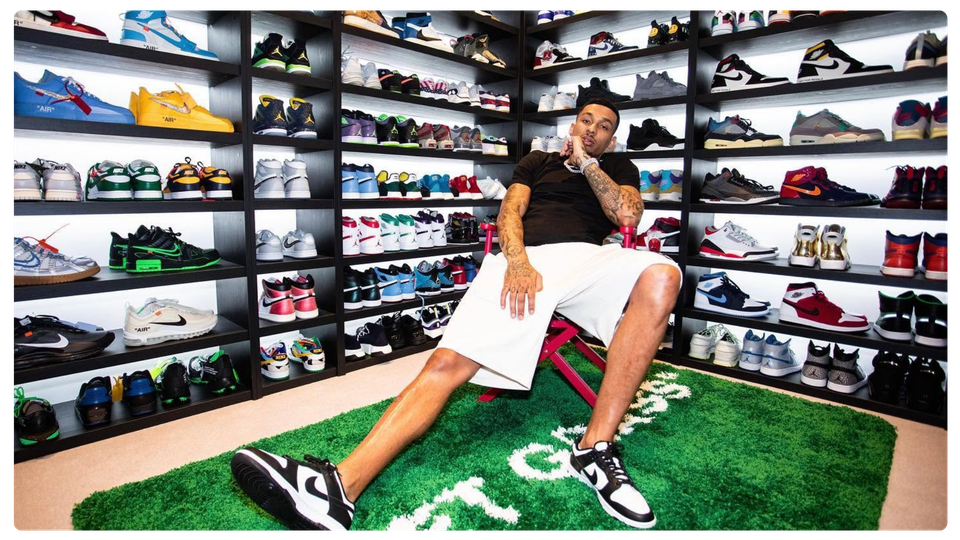
Kick Game is a UK retailer of sneakers and streetwear, trading at kickgame.co.uk, with a range built around limited-edition and hard-to-source releases from brands including Saucony, Asics, Jordan and On. The commercial model depends on breadth and turnover. New drops arrive constantly, sizes sell through unevenly, and the value of any given pair depends heavily on which size it is.
That last point shapes everything about how the catalog has to be modeled. In a conventional apparel catalog, a style has a price and its sizes inherit it. In Kick Game’s catalog, size is a pricing dimension in its own right, because scarcity varies by size. A UK 9 and a UK 12 of the same release are, commercially, two different products at two different prices.
Kick Game became an Athos Commerce customer in 2025 and moved onto the Athos console in 2026. The company works with agency partner Wiro on its storefront.
The challenge
Two problems limited on-site discovery.
The first was visible to every shopper. Filters were surfacing products that were out of stock. A shopper narrowed to their size, found something they wanted, and discovered it was unavailable. That pattern costs more than the individual sale, because it teaches shoppers that the filters cannot be trusted. On a catalog this large, a shopper who stops trusting filters has no other way through it.
The second was structural. Kick Game prices at size level rather than product level, and most search and merchandising platforms have no way to represent that. Price lives on the product record, sizes are variants beneath it, and a price filter reads the product. In a catalog where size is what determines price, that architecture produces a filter that cannot answer the question shoppers most want to ask.
This was the deciding factor when Kick Game evaluated replacements. In the team’s assessment, Athos Commerce was the one platform that could filter at size level, and that conclusion moved the account off its incumbent merchandising provider.

Objectives
Kick Game set three objectives for the replacement.
- Make filtered results true: stop returning out-of-stock products, so that narrowing a catalog returns products a shopper can buy.
- Filter and price at the level the business sells at: treat size as a pricing dimension in its own right instead of an attribute inherited from a parent product.
- Cover the whole site with page-level merchandising: replace a single broad rule set applied everywhere with strategy built per page, without adding proportional manual work.
The solution
Kick Game runs the Athos Commerce discovery suite across search, filtering, merchandising, recommendations, and analytics. Three parts of it changed how the team works.
Merchandising without a campaign cap. Kick Game’s previous setup limited how many merchandising campaigns could run at once, and the practical consequence was a single broad campaign applied across all collections, kept relevant by hand. Athos removes that limit. The team now runs its core cross-collection campaign alongside a growing set of campaigns built for specific high-value pages, and the ranking algorithms absorb work the team used to do by hand. Every page on the site is now covered by a deliberate merchandising strategy, which was not reachable under a campaign cap. Kick Game also gained merchandising control over the search results page, which it did not have before.
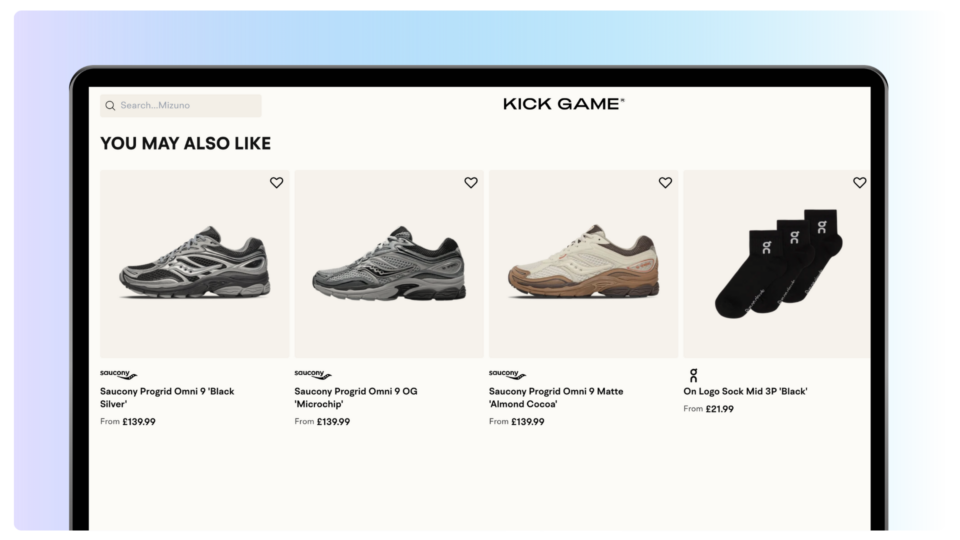
Recommendations beyond a single block. The previous strategy amounted to a “you might also like” module and a recently-viewed carousel. Kick Game has since built cross-sells, product blocks on the homepage, and recommendation placements inside site navigation. One test moved the recently-viewed block from the bottom of collection pages to the top for returning visitors, on the reasoning that a shopper who has already browsed benefits from seeing what they looked at before they scroll. Engagement with that block improved.
Search and filter analytics as a buying input. Search and filter data tells Kick Game which sizes and which brands shoppers are looking for, including demand for sizes and brands the catalog does not carry in depth. The team uses that to shape its size curves, which connects on-site discovery data to purchasing and stock decisions instead of leaving it inside a marketing report.
Results
Kick Game’s conversion rate has tripled over the past year, reaching the highest level in the business’s history. While several changes to the ecommerce store have contributed to this growth, Kick Game credits Athos Commerce as a major driver of the uplift.
- 5.2x higher conversion rate among visitors who use site search.
- 4.5x higher revenue per visit among visitors who use site search.
Jack Turner
Looking ahead
Kick Game is waiting on slotted merchandising, which will let the team place specific products in specific positions alongside algorithmic ranking. That control matters more for a fashion retailer than it would elsewhere. A drop or a seasonal story is a curation decision, and conversion optimization will not make it.
Jack Turner
What transfers to other retailers
- Model price at the level you actually sell at. If scarcity, condition, or size changes what a unit is worth, price is not a product attribute, and a platform that treats it as one will produce a price filter that lies. Kick Game’s evaluation turned on which platform could filter at size level, because that single capability determined whether its most-used filter worked. Establish it as a requirement during evaluation, since it is architectural and cannot be configured in afterward.
- Check whether your filters return things shoppers can buy. An out-of-stock product in a filtered result costs the sale and also damages the navigation path that produced it. On a catalog too large to browse, filters are the only route to a product, so their accuracy sets the ceiling on everything downstream.
- Count your merchandising campaigns against your page count. A campaign cap forces one broad rule set across every collection, and the pages that most deserve specific treatment are the ones that suffer. Kick Game went from a single site-wide campaign to page-level strategy across the site without adding proportional manual work, because the ranking algorithms absorb the maintenance the team used to do by hand.
- Merchandise the search results page. It receives shoppers with the clearest stated intent on the site, and it is routinely left to a default relevance sort. Kick Game did not have merchandising control there before and does now.
- Route search and filter demand to the buying team. Search queries record demand for products that are not in the catalog yet, or not in the right depth. Kick Game uses that signal to shape size curves, which turns discovery analytics into an inventory input. Most retailers read the same data only as a search-tuning report.
The size-level pricing problem is what brought Kick Game to Athos Commerce. What kept the account expanding is that fixing the data model made everything built on top of it worth configuring.
Partner with Athos Commerce to transform your ecommerce store. With proven tools and expertise in search and merchandising, we empower businesses to achieve measurable growth. Contact us today to start optimizing your store for success.