






How AI agents and Google’s Merchant API are reshaping agentic checkout
For years, the point of a product review was to convince another human. A shopper looked at the star ratings, read a few reviews, and reconciled those inputs with the complaints before deciding. Increasingly, though, the first reader of your reviews is an AI agent, deciding whether to recommend your product to a shopper and, soon, whether to buy it on their behalf.
It is already happening. In the Drapers and Athos Commerce Connected Consumer 2026 survey of 2,000 UK shoppers, 60% now use AI tools somewhere in their shopping journey, and 38% say they trust fashion recommendations from AI tools, against 26% who distrust them.1 That trust has to come from somewhere, and an agent finds much of it in your product reviews.
A May panel hosted by The Fashion Network, Ecommerce Club, and Athos Commerce, the intelligent discovery platform for ecommerce brands, traced where this is heading. Its wider recap mapped how discovery is fragmented across AI assistants, creators, and marketplaces, and a companion piece followed creators into the social feed. This article follows the shopper one step further, to the moment an AI agent reaches checkout. Your reviews have become inputs to a machine’s purchase decision. Structure your product review and make it available to your key channels so the agent can read them, or risk the agent inferring product sentiment and usability from communities like Reddit instead.
How an agent reads a review
An AI agent does not glance at a star rating and move on. It reads the text. Asked for “a waterproof jacket that runs true to size for tall men,” the agent mines your reviews for the sentences that answer the question, a process of sentiment synthesis that turns unstructured customer language into a yes-or-no on your product. Reviews become a decision-grade trust signal.

Stephanie Brown
That puts a premium on substantive, verifiable reviews. The Athos and Pixel Discovery Gap survey found that 76% of shoppers already rate reviews as important or very important, and that written reviews (58%) matter far more than star ratings alone (15%).2 What an agent weighs (aggregate rating, review volume, and verified-purchase flags) and the “trust tax” you pay when that data is missing are both covered in our guide to the Trust Stack.3 In that earlier framing, those signals won the recommendation. With agentic checkout arriving, they now decide the purchase.
Agentic checkout raises the stakes
Until recently, an AI agent’s job ended at the recommendation, and the shopper still clicked through and checked out themselves. That is changing. On the May panel, Stephanie Brown noted that Google is moving out of beta in the US for agentic checkout, where an AI agent completes the transaction within the AI Chat interface (Gemini or Google AI Mode) while still using the website’s operations.4
When the agent buys on the shopper’s behalf, the job of your reviews changes from persuading a person to satisfying a machine that is about to spend someone else’s money. The agent has to convince itself that the product is the right one, that the seller is legitimate, and that the buyer will be protected. Thin or missing review data gives it a reason to choose a competitor it can stand behind.
The demand is already pulling in this direction. In the Connected Consumer 2026 survey, 39% of shoppers say they are open to completing purchases through AI platforms, rising to 50% of Gen Z and falling to 21% of Gen X, and 7% report having already bought something through an AI tool.5 Seven percent is small, but it was near zero a year ago, and the brands an agent learns to trust now are the ones it will keep choosing as that share climbs.
The plumbing: Google’s Merchant API and product-level reviews
Knowing reviews matter to agents is one thing. Getting them in front of an agent is a product feed problem, and the plumbing underneath is changing. Google is replacing its long-standing Content API for Shopping with a new, modular Merchant API (splitting various features into independent Sub-APIs), and as part of that work, it has recently shipped a dedicated sub-API for product reviews that lets sellers push review data straight into Google Merchant Center.6 Instead of manually uploading XML or text feeds to Google Merchant Center to get those coveted golden star ratings on your Shopping Ads and organic listings, the Product Reviews sub-API allows you to programmatically syndicate, upload, update, and manage your customer feedback directly from your platform or review aggregator
On the panel, Stephanie Brown tied that move directly to where checkout is going.
Stephanie Brown
Read the two developments together, and the direction is hard to miss. Google’s Universal Commerce Protocol now enables agentic actions, including direct buying, inside AI Mode in Google Search and Gemini, and the reviews sub-API gives those same agents structured trust data to reason over at the point of decision.7 The review you used to display on a product page becomes a field that the agent ingests before recommending or buying.
For a retailer, the practical consequence is a change in where reviews have to live. Reviews rendered only in an on-site widget, in JavaScript that the feed never sees, are invisible to this pipeline. To count, the same review data (aggregate score, review count, and verified-purchase status) has to be structured in the feed that Google and other engines ingest, and it has to pass each platform’s validation to be eligible. That is feed management work, not a website task, and it is the part most teams have not started.
The Trust Stack from our earlier analysis gains a delivery mechanism here. The framework named the signals agents need; the Merchant API is becoming the road they travel.
The signal you can’t fake
There is a temptation, once reviews become ranking fuel, to manufacture them. It does not work the way gaming a keyword once did. An agent reading the full text of your reviews is also reading the complaints, the fit notes, and the photos customers post, and is increasingly trained to discount synthetic sentiment. The reviews that help you are the real ones, which means service quality is now part of the listing the agent reads.
Alex Green, a fractional head of ecommerce on the panel, made the human version of the point. He once gifted a customer a black T-shirt and drew a one-star review because they had wanted red. You cannot second-guess shoppers or script them. You can, though, treat their feedback as the data an agent will eventually act on, fixing the product and service problems it surfaces instead of burying them.8
Reviews are product feed data now
Only 14% of shoppers say a product’s details always match when they move from a marketplace or social platform to a brand’s site.9 That inconsistency is the exact doubt an AI agent is built to resolve, and reviews are among the strongest signals it uses to resolve it. A review that lives only on your website, separate from the feed and out of sync with your marketplace listing, gives the agent nothing to work with.

Gary Lombardo
Reviews have become structured feed data that helps decide whether an agent trusts your product enough to put it in someone’s cart. Getting them into that feed, accurate and consistent everywhere a shopper or an agent might look, is what Athos Commerce means by intelligent discovery.
Where to start this quarter
Three moves prepare your reviews for the agent who will read them. Each one depends on treating discovery as one connected system, not a stack of point tools.
- Put review trust signals on the same product record as your search and feed: Move aggregate rating, review count, and verified-purchase flags out of a standalone review app and onto the enriched product record that powers your on-site search and your off-site feed, so an agent reads one consistent signal whether it meets your product on your site, a marketplace, or ChatGPT.
- Score your catalog the way an agent will, then fix it at the feed level: Audit which products carry enough verified reviews to clear an agent’s trust bar and which will be skipped, and correct the feed fields rather than the on-site widget. Run it as a continuous audit, fix, and test loop, not a one-time cleanup.
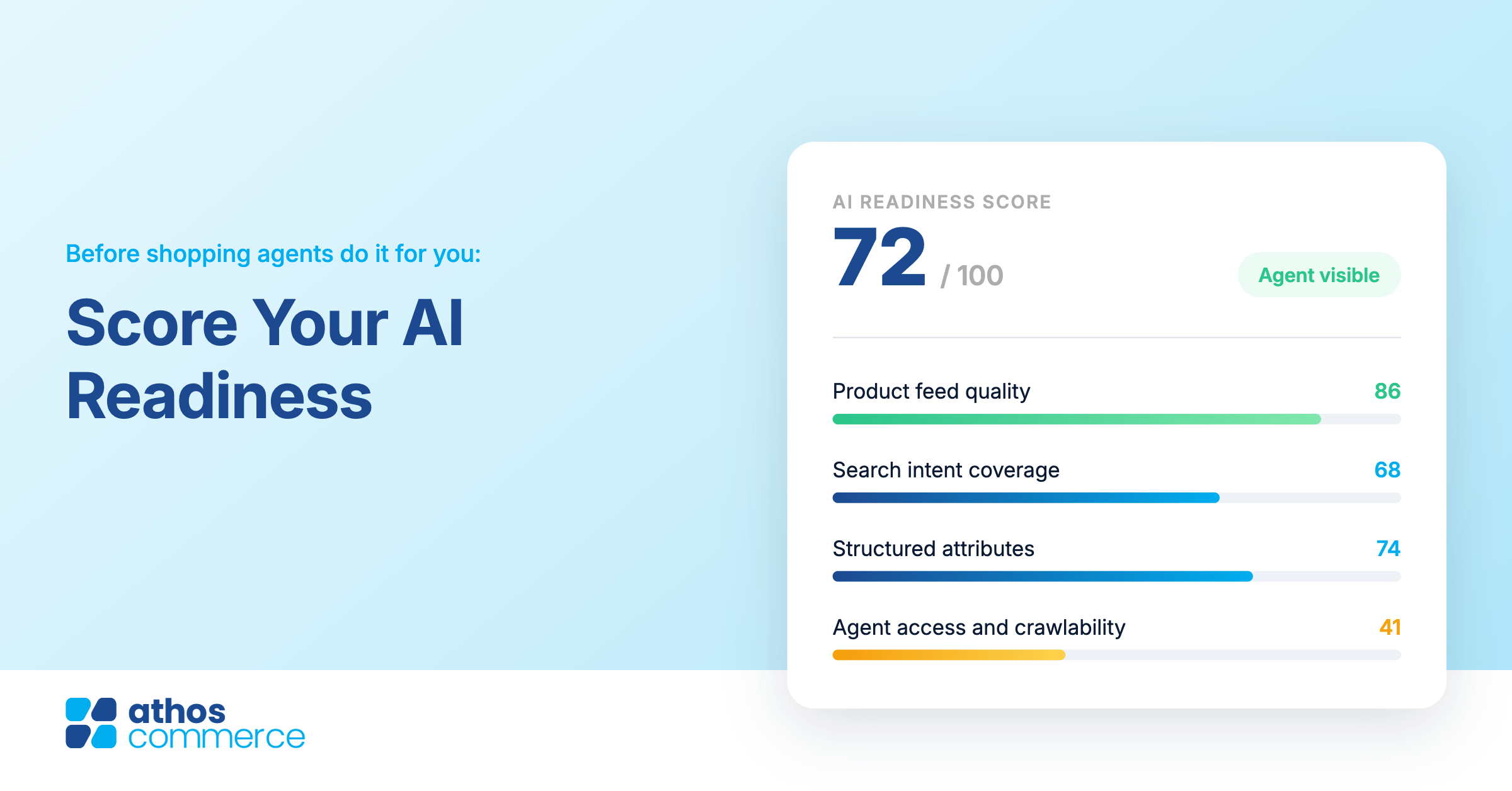
- Make agent-readiness one workflow across every channel, not a one-off Merchant API integration: Google’s review sub-API is one channel. The readiness that lasts is the same enriched record feeding Google, the AI answer engines, and your marketplaces from one system, so start with a single on-site and off-site discovery audit. Athos offers a free feed and site audit as a starting point.
Frequently Asked Questions
What is agentic checkout?
Agentic checkout is when an AI agent completes a purchase on a shopper’s behalf, often outside the retailer’s website, while still using the website’s systems to place the order. Google is moving out of the US beta for this through its Universal Commerce Protocol, which enables direct buying inside AI Mode in Google Search and Gemini. For retailers, it means an AI agent, not a person, evaluates your product data and trust signals at the moment of purchase.
Why do reviews matter for AI agents?
Reviews matter because AI agents perform sentiment synthesis: they read the actual text of your product reviews to answer specific shopper questions, such as whether an item runs true to size, then use that to decide whether to recommend or buy. In the Athos and Pixel Discovery Gap survey, 76% of shoppers rate reviews as important or very important, and written reviews (58%) outweigh star ratings alone (15%). For an agent, a product review is a decision-grade trust signal, not decoration.
What is the “trust tax”?
The “trust tax” is the cost a retailer incurs due to lower AI visibility when review data is missing from the product feed. When an agent cannot find structured review signals (aggregate rating, review count, verified-purchase flags) in your feed, it sources social proof from Reddit or third-party blogs instead. You lose control of the narrative, and the recommendation often goes to a competitor whose feed data is complete.
What is the Google Merchant API product reviews sub-API?
Google is replacing its Content API for Shopping with a modular Merchant API, and has added a dedicated sub-API for product reviews that lets sellers push review data directly into Google Merchant Center. It makes reviews first-class feed data Google can ingest for AI-driven discovery, and, according to Athos’s Stephanie Brown, it is closely tied to the adoption of agentic checkout. Product reviews that live only in an on-site widget are invisible to this pipeline.
How do I make my product reviews agent-ready?
Move your review trust signals out of a standalone review app and into the enriched product record that powers both your on-site search and your off-site feed, so an agent reads one consistent signal everywhere. Structure aggregate rating, review count, and verified-purchase status in the feed, confirm it passes each platform’s validation, and keep it consistent with your marketplace listings. This is feed management work, not a website task.
How does this build on the Trust Stack?
The Trust Stack is the Athos Commerce framework that identifies the feed attributes an AI agent needs to move from recommendation to purchase, including review, shipping, and return data. This article extends it to the checkout stage. With agentic checkout arriving and Google’s Merchant API adding a product reviews sub-API, reviews become the delivery mechanism for trust at the moment an agent buys. The framework names the signals; the Merchant API is how they reach the agent.
Sources & Further Reading
- Drapers and Athos Commerce. “Connected Consumer 2026.” Report, June 2026. Survey of 2,000 UK consumers. https://www.drapersonline.com/guides/connected-consumer-2026.
- Athos Commerce and The Pixel. “The Discovery Gap: What 800 Shoppers Reveal About Product Discovery.” Research report, January 2026.
- Athos Commerce. “Beyond Data Feeds: Winning the hift to Agentic Commerce.” Webinar, March 4, 2026. https://athoscommerce.com/webinars/winning-the-shift-to-agentic-commerce/.
- The Fashion Network, Ecommerce Club, and Athos Commerce. “The New Retail Funnel: How to Win Product Visibility in the Age of AI.” Panel webinar, May 20, 2026.
- Drapers and Athos Commerce. “Connected Consumer 2026.” Report, June 2026. Survey of 2,000 UK consumers. https://www.drapersonline.com/guides/connected-consumer-2026.
- Google. “Merchant API” (Reviews sub-API; Universal Commerce Protocol). Google for Developers, accessed June 2026. https://developers.google.com/merchant/api.
- Google. “Merchant API” (Reviews sub-API; Universal Commerce Protocol). Google for Developers, accessed June 2026. https://developers.google.com/merchant/api.
- The Fashion Network, Ecommerce Club, and Athos Commerce. “The New Retail Funnel: How to Win Product Visibility in the Age of AI.” Panel webinar, May 20, 2026.
- Drapers and Athos Commerce. “Connected Consumer 2026.” Report, June 2026. Survey of 2,000 UK consumers. https://www.drapersonline.com/guides/connected-consumer-2026.