







If you’ve ever heard the expression “pressure makes diamonds”, there’s a fair chance you work in ecommerce. Right now, that figure of speech is more relevant than ever. You see, diamonds are crystallized carbon, formed deep underground under enormous heat and pressure over millions of years. Online retailers are feeling plenty of heat and pressure, just on a faster timeline.
As costs climb, budgets face increased scrutiny. In the US, tariffs have laid a heavy toll on retail costs. Across 2025, they raised the retail prices of imported goods by around 7 percentage points, and clothing by roughly 17.5 percentage points, according to the Tax Foundation’s reading of real-time retail price data.1 Even with some of those tariffs scaled back, the administration has signaled more to come.
Acquisition costs are also on the rise. Tinuiti’s Q1 2026 Digital Ads Benchmark Report found that brands are increasing spend on Google paid search 14% year on year.2 They’re essentially spending more to capture the same demand. Meanwhile, consumer confidence has seen near-record lows. Smaller order volumes and softer average order values (AOV) often follow this trend.
So the heat is real. The good news is that this kind of pressure tends to separate reactive retailers from proactive ones. That sentiment ran through our recent Discovery Day webinar, where Kate Massey from Athos Commerce hosted an enlightening discussion with Joe Sharplin, Head of Ecommerce at AS Colour, Adam Ioakim, Head of APAC at Triple Whale, and Andrew Waite, Founder and CEO of Convert Digital.3 The resounding takeaway? A cautious market does not mean a lack of opportunity. It means the opportunity has moved toward geographies and product categories with the strongest demand, including international markets where confidence is lifting. As Kate elaborated:
Discovery has moved, and so has the data that powers it
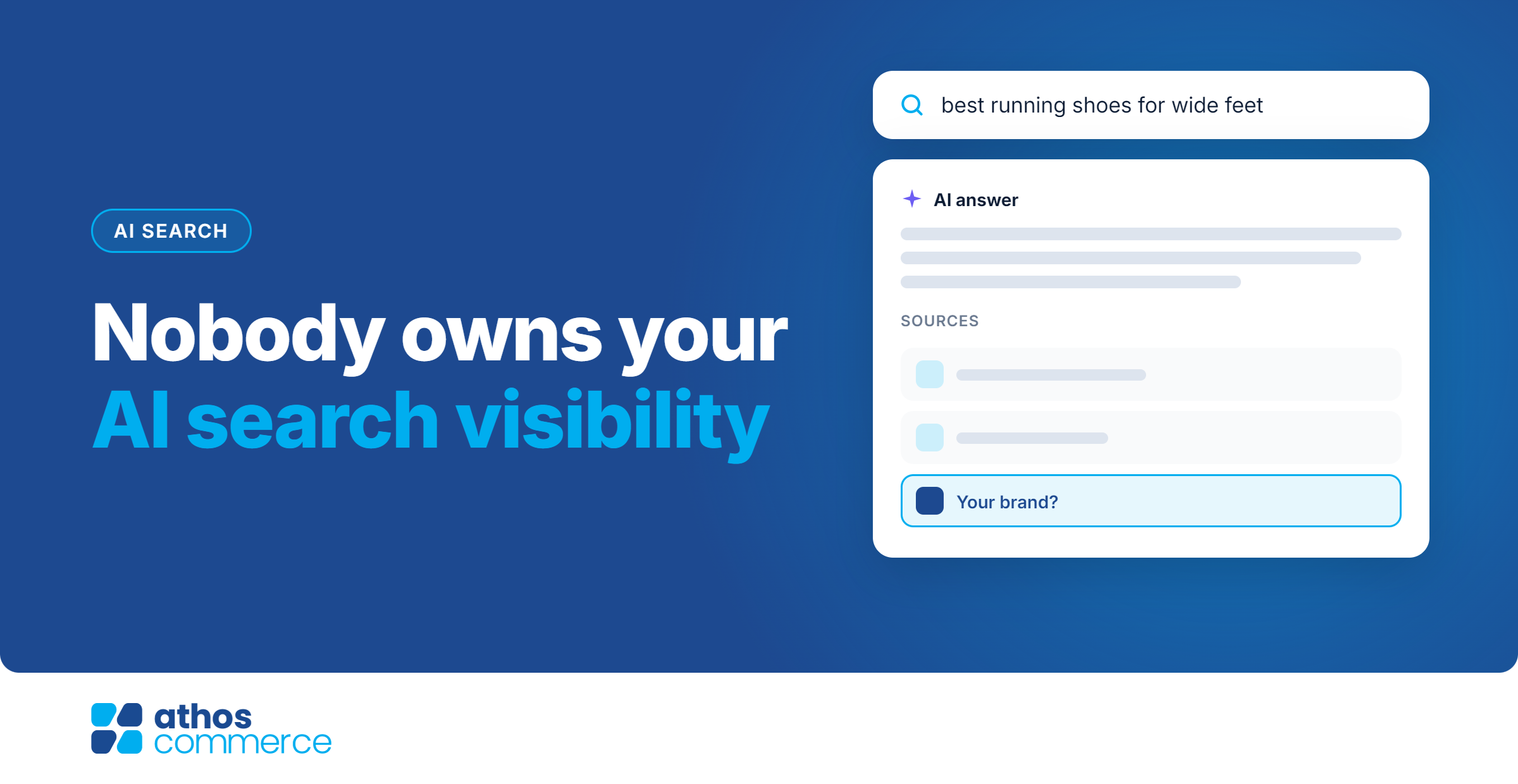
The way people find products has shifted faster than many retailers’ roadmaps have. Shoppers are now starting their shopping journey in generative AI tools rather than a search bar. Research from Future Commerce found that 52% of consumers have used generative AI platforms to shop, and 80% turn to AI first when researching gifts and holiday season purchases.4 Add Google’s AI Overviews, becoming the default answer in many search results pages, and a sizable share of discovery now happens before a shopper reaches your site.
The catch is that these engines are only as good as the product data feeding them. A sparse, inconsistent, or out-of-date feed simply won’t surface where shoppers discover products and brands. Adam explains:
The problem isn’t too little data, it’s too much of the wrong kind
Most retailers have plenty of data to work with. The roadblock is where it sits, often across various tools that don’t talk to each other, with each reporting a slightly different version of the truth. Retailers are left making budget, creative, and operational calls based on numbers they can’t always trust. Every decision is impacted by that fragmentation, slowing down strategy and accelerating reactions to spend more on acquisition.
Adam framed the cost of guessing with an analogy worth remembering.
Andrew also sees this pattern with many clients. Merchandisers update collections by hand. Operations teams stitch reports together from systems that never see eye to eye. The strategic work that actually moves the revenue needle gets pushed back. As Andrew described:
What optimized data feeds underpin: the AS Colour story
AS Colour adds an important proof point because its data is genuinely complex. The New Zealand apparel brand operates across five regions and is roughly 97% B2B, with a growing direct-to-consumer (D2C) arm on an international scale. That kind of complexity makes optimized, enriched product data feeds an essential part of doing business. Joe talked candidly about those data foundations coming first.
While ensuring shoppers discover the brand is vital, so too is removing friction once they land on the website. AI-powered site search, personalized product recommendations, and automated merchandising continue the journey from discovery to conversion. After implementing the Athos Commerce intelligent discovery solutions, AS Colour saw a 18.2% average conversion rate from on-site search. 53% of revenue now draws from search on average, with that figure climbing above 60% in core markets like Australia, the US, and New Zealand. Personalized recommendations delivered a seven-figure impact in major markets and influenced around $1 million AUD per market within the first ninety days of implementation. As Joe mentioned:
Small gains, compounded, beat big bets
The commercial case rarely rests on one dramatic win. It comes from disciplined optimization that compounds. The results shared by Athos’s partners during the webinar illustrate this point perfectly.
Meshki wanted to invest more in discovery channels like Pinterest, but lacked a trustworthy, consolidated view of what was working. By using Triple Whale as its source of truth and feeding richer conversion data into Pinterest’s optimization, the brand recorded a 43% uplift in triple attribution return on ad spend (ROAS) and a 52% increase in linear paid ROAS compared to the control group. The investment decision became evidence-based rather than guesswork.
Convert Digital‘s work with Showpo tells a similar story from the experience side. Replatforming the fashion retailer to a headless Shopify build reduced homepage load time from 15.8 seconds to 1.4 seconds and product page load time from 10.1 seconds to 0.7 seconds. As a result, conversion rate rose by 7.7% and AOV by 8.3% in just three months after launch. As Andrew noted, the retailers winning right now are rarely doing one enormous thing on site. They are doing lots of small things that add up to a material shift in unit economics.
The discovery optimization checklist
Kate closed the session with a set of questions every retailer should ask themself right now, with further insights from the panel.
Are your product feeds enriched and optimized per channel?
A single Google feed pushed into every platform isn’t enough to move the needle. Look at title structures, product images, and product typing, using up to five nodes on Google, then test which elements actually lift visibility and performance on each channel.
Are you treating the product data feed as a living asset?
Seasonality, product trends, and peak promotions all shift demand, so a set-and-forget feed will leave with visibility gaps. Lean into your product data feeds to extend your reach before reaching for more paid spend.
Are you adapting with your shoppers?
Adam pointed out that the audiences on Pinterest, TikTok, and Snapchat are aging, so test them rather than assuming they may not be the right demographic for your brand.
Are you shopping your own site the way a customer would?
Be sure the right products, recommendations, and upsells are appearing on your site by shopping on it the way your customers do. Andrew’s first rule in optimizing for conversion is to “get out of the way”. Strip friction from the path to purchase, fix the obvious checkout gaps, and treat mobile performance as table stakes, since the majority of traffic now arrives there.
Are you converting the shopper intent you’re already paying for?
If your website converts at 1.5% to 2%, focus on the practical wins that will move the next fraction of a percentage, because that’s where the revenue needle moves.
Have you freed your team from manual work?
Automation and AI enrichment exist to hand time back. Joe’s team built an AI tool that turns a five-page B2B purchase order into a filled cart in under two minutes, recovering hours every morning for higher-value work.
Are you measuring profitability, not just growth?
First-party data and the full path to purchase matter more than the last click. Growth at all costs may be limiting your profitability potential.
Is your data foundation ready for what comes next?
Andrew’s advice is that being AI curious is easy. However, being AI ready is a question of data maturity, and if that is not near the top of your strategic roadmap, it should be.
Turning pressure into diamonds
For retailers, what turns pressure into something valuable is the structure you build underneath it. That structure is intelligent product discovery built on clean, enriched data, supported by exceptional on-site experiences.
Get the foundations right, and data becomes the diamonds of your retail operations. Your products and brand surface wherever shoppers look, from Google and Meta to marketplaces and AI assistants. The shoppers who arrive are far more likely to convert because search, merchandising, and recommendations are doing their job. AOV lifts as you put more of the products shoppers will love in front of them at the moments that matter most in the journey.
The Athos Commerce team is redefining discovery for online retailers. Consider these five important next steps the team can guide you through to turn more shoppers into returning customers:
- Audit and enrich product data so it performs across search, social, marketplaces, and AI discovery
- Optimize and test feeds per channel rather than syndicating one generic version
- Connect on-site search, merchandising, and recommendations to lift conversion and average order value
- Automate the manual work so your team can focus on growth
- Turn performance data into your next round of feed decisions
The heat is not going anywhere. In retail, there is always the next challenge on the horizon. However, the right foundations create the conditions to produce something brilliant. If you are ready to make the pressure work for you, schedule your complimentary demo of the Athos Commerce platform now.
About Athos Commerce
Athos Commerce is the only intelligent product discovery platform that connects shoppers to the right products across on-site and off-site channels. More than 2,000 brands use Athos Commerce to power AI-driven search, merchandising, personalisation, and product feed management from a single platform. Customers include Rip Curl, Kathmandu, David Jones, Endeavour Group, Accent Group, and many more. With commerce roots dating to 2007, Athos Commerce operates across Asia-Pacific, North America, and Europe.
FAQs
What is product discovery in ecommerce?
Product discovery is how shoppers find products across the channels they use, from on-site search and recommendations to Google, Meta, marketplaces, and AI assistants like ChatGPT and Perplexity. It increasingly begins off-site. Future Commerce found that 52% of consumers have used generative AI platforms to shop and 80% turn to AI first when researching gifts and holiday purchases. Strong product discovery depends on clean, enriched product data feeds that let your catalog surface accurately wherever buyers are looking.
Why do product data feeds matter for AI-driven discovery?
AI search tools and shopping engines can only recommend what they can read, so their output is only as good as the product data feeding them. A sparse, inconsistent, or out-of-date feed won’t surface when a shopper asks an AI assistant or scans Google’s AI Overviews. Enriched feeds with accurate titles, images, and product typing, using up to five nodes on Google, give these engines the structured detail they need to match your products to buyer intent.
How is optimizing product feeds different from increasing ad spend?
Increasing ad spend buys more visibility at a higher cost. Tinuiti’s Q1 2026 data shows brands lifting Google paid search spend 14% year over year to capture the same demand. Optimizing product feeds instead improves how well your existing products surface and convert, so each dollar works harder. With margins under pressure, and Australian purchase costs rising 4.5% in April against 1.8% price growth, feed optimization protects profitability rather than simply chasing volume.
Where should retailers start when product discovery performance dips?
Start with the data, not the ad budget. Audit your product feeds for completeness and accuracy, then optimize and test them per channel rather than pushing one generic Google feed everywhere. From there, reduce on-site friction so the traffic you already pay for converts, and use recommendations to lift average order value. AS Colour grew search to 53% of revenue on average, climbing above 60% in core markets, by getting these foundations right first.
How can retailers improve product discovery without increasing budget?
Treat the product feed as a living asset, refreshing it for seasonality, trends, and promotions rather than setting and forgetting it. Test which titles, images, and attributes lift performance on each channel, automate manual enrichment to free up your team, and shop your own site the way a customer would to catch gaps in search, recommendations, and checkout. Showpo lifted conversion 7.7% and AOV 8.3% through compounding on-site improvements, not a bigger budget.
What does Athos Commerce do?
Athos Commerce is an ecommerce product discovery platform for online retailers. It helps brands audit and enrich product data feeds, optimize and test them per channel, and connect on-site search, merchandising, and recommendations so products surface and convert across search, social, marketplaces, and AI discovery. Retailers using the platform include AS Colour, which reported an 18.2% on-site search conversion rate and a seven-figure recommendation impact in major markets within ninety days of implementation.
Sources & further reading
- Tariffs Increased Retail Prices of Imports by 7 Percentage Points Prior to Supreme Court Ruling March 3, 2026 https://taxfoundation.org/blog/trump-tariffs-raise-prices-consumers/
- Digital Ads Benchmark Report Q1 2026 https://tinuiti.com/research-insights/research/digital-ads-benchmark-report/
- Ecommerce Discovery Day: Celebrating Success and Preparing for Peak Performance May 27, 2026 https://athoscommerce.com/webinars/ecommerce-discovery-day/
- The Concierge Economy: Understanding AI’s True Role in the Shopping Experience, Jan 09, 2027 https://www.futurecommerce.com/posts/guide-the-concierge-economy-understanding-ais-true-role-in-the-shopping-experience