








The Brand
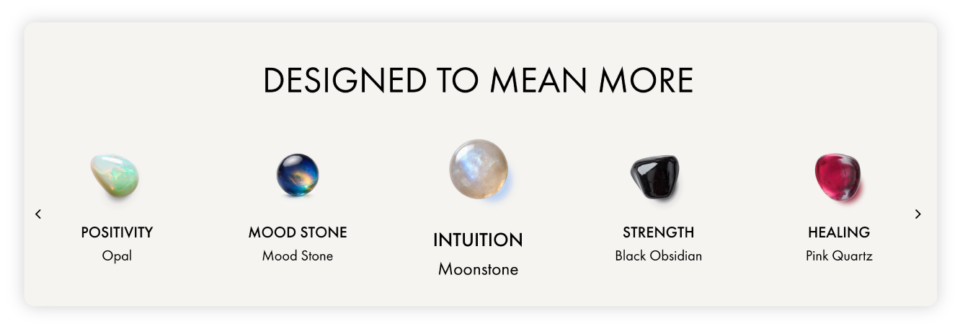
Moon Magic is a direct-to-consumer (DTC) fine-jewelry brand selling gemstone pieces tied to symbolism and intent. Each stone is chosen for what it represents, from strength to intuition to calm. Customers shop by intention as much as by category, and Moon Magic markets that way. A line like “Black Obsidian for overthinking” works as a product positioning statement, an ad creative, and, increasingly, a customer search query.
Moon Magic
Moon Magic operates on Shopify, driving traffic through Meta, Google, email, and organic social. The team doesn’t benchmark itself against other gemstone shops. It benchmarks against premium DTC brands like Missoma, where discovery feels effortless. The old tools could no longer meet that standard.
The healing crystal segment Moon Magic sits in was worth roughly $1.5 billion in 2022 and is projected to grow at 10.2% annually through 2030, according to Grand View Research.1 Consumers are driving that growth, looking for meaning, mindfulness, and a stronger connection between what they buy and how they want to feel. The catalog already matched that demand. The search experience had not.

The Challenge
Moon Magic’s customers shop by intention, but the brand’s previous search and merchandising platform was built for keyword matching. The biggest disconnect was at the query itself. A shopper typing “anxiety” or “self-love” expects to find a curated set of relevant gemstones, but the old tool returned a loosely matched mix that customers had to wade through.
Site-search users typically convert at 1.7 times the rate of non-search visitors, according to eConsultancy, but only when search returns what they’re looking for.2 Moon Magic’s previous platform couldn’t reliably make that translation. Conversions slipped at the moment when intent was strongest, with no analytics in place to tell the team where or why.
The aesthetic compounded the problem. Moon Magic’s site is built around a premium experience, but the previous search interface felt generic and visually disconnected from the rest of the brand. For shoppers spending time and money on jewelry tied to meaning, a jarring search bar broke the spell.
Operational drag followed. Product-ranking updates required manual effort, and the analytics behind the old tool didn’t surface what was failing. The team couldn’t reliably identify which queries returned poor results, which gemstones were being searched for but missed, and which collection pages were underperforming.
Customer support absorbed the spillover. Before the change, Moon Magic’s support team handled “can’t find this product” requests multiple times per week, most of which pointed to specific gemstones, collections, or designs that shoppers knew existed but couldn’t surface via search. Each ticket was a small failed handoff between intent and discovery, and the cost compounded across staff hours, customer patience, and the revenue lost to abandoned sessions.
Moon Magic

The Solution
Moon Magic evaluated several search and merchandising solutions, including Algolia and Doofinder, before selecting Athos Commerce. Athos Commerce is the intelligent discovery platform that connects shoppers to the right products across on-site and off-site channels. Two factors decided the call. Athos delivered the functionality Moon Magic needed at a price point that worked for a DTC brand of its scale. The backend was intuitive enough for the team to manage rankings and tune search results without leaning on engineering support.
The aesthetic problem went away in the first week. Athos’s search experience matched the visual language of the rest of the Moon Magic site, restoring the premium feel customers expect from the moment they open the search bar. For shoppers buying jewelry tied to meaning, search now felt like part of the brand.
Underneath the aesthetic fix sat the more meaningful change. Athos’s search learns from how customers engage with the catalog, so queries built on intention rather than product names started returning the right gemstones. A shopper typing “self-love” began landing on Rose Quartz instead of an alphabetical sprawl. A search for “anxiety” surfaced the calming gemstones Moon Magic markets in that manner. The translation Moon Magic’s customers had always needed lands at the query level.
The Results
Moon Magic adopted Athos partly to gain visibility they didn’t have before. Under the previous platform, the analytics couldn’t support a clean before-and-after comparison, so the proof shows up in operational signals rather than dashboard deltas.
The most visible change shows up in customer support volume. Before Athos, Moon Magic’s support team handled “can’t find this product” requests multiple times per week, most of which pointed to specific gemstones, collections, or designs that customers knew existed but couldn’t locate. Since the switch, those requests have dropped to a fraction of their previous volume, freeing the team to return to the higher-value work it had been pulled from.
A second pattern surfaced once Athos’s search analytics gave Moon Magic visibility that the team didn’t have before. New gemstones and product launches are being searched within days of release, sometimes using the exact taglines from Moon Magic’s ad creative and email marketing. The brand can now see, in real time, how marketing language maps to customer queries, creating a feedback loop most retailers don’t measure.
The internal team felt the same lift. Moon Magic’s merchandisers used to scroll through collections by hand to locate specific items, a task that grew slower as the catalog expanded. Now they search the site the same way customers do, finding products in seconds and moving straight to optimization.
Moon Magic’s leadership names a less obvious benefit. When the team can see what customers are searching for and whether new arrivals are reaching them, the risk profile of launching a new collection drops. The catalog can grow without outpacing the discovery experience.
These results came without before-and-after dashboards. The previous platform’s analytics couldn’t support a clean comparison, so the proof shows up in operational signals like support tickets that no longer arrive, launches that find their audience, and time the team has reclaimed.
Future Plans
Moon Magic’s roadmap points further into intent. The team wants Search to handle the most emotional queries it sees, like “stress relief” or “calming anxiety,” and return the right gemstone, whether or not the shopper knows the gemstone name. AI agents shopping on behalf of customers will need the same translation layer.
By 2030, Gartner predicts that 20% of monetary transactions will be programmable, giving AI agents the economic agency to shop on customers’ behalf.3 Brands built on meaning, wellness, and outcomes will need a search infrastructure that can take a feeling and find a product. Moon Magic is an early example of what that infrastructure looks like in practice.
Moon Magic
Partner with Athos Commerce to transform your ecommerce store. With proven tools and expertise in search and merchandising, we empower businesses to achieve measurable growth. Contact us today to start optimizing your store for success.
Frequently asked questions
What does Moon Magic sell, and why does product discovery matter for the brand?
Moon Magic is a direct-to-consumer (DTC) fine-jewelry brand specializing in gemstone pieces tied to symbolism and intent, sold through a Shopify storefront. Each gemstone is selected for what it represents, from strength to intuition to calm. The brand’s customers shop by intention as much as by category, often searching for outcomes like “overthinking” or “self-love” rather than product names. That pattern breaks standard keyword-based ecommerce search and makes intent-aware discovery a strategic priority.
How does intent-based search differ from traditional keyword search?
Traditional ecommerce search assumes the shopper types a product name or category, then matches that input to inventory. Intent-based search treats the query as a signal of what the customer is trying to accomplish, including emotional or outcome-oriented queries like “calming anxiety” or “Black Obsidian for overthinking.” It maps that intent to the right products even when the shopper doesn’t know the product or gemstone name. For brands selling meaning, gifting, or wellness, intent-based search is the difference between a conversion and an abandoned session.
Why is search particularly important for DTC brands selling meaning, wellness, or gifting?
Customers in these categories often don’t know the exact product name they want. They search for outcomes like relief, calm, or a sense of a gift recipient, and expect the site to translate those into a relevant product. Standard search returns loose matches that customers must filter through, increasing friction and abandoned sessions. According to Baymard Institute, 56% of major ecommerce sites have mediocre or worse search UX, and brands whose customers shop by feeling are disproportionately affected. Intent-aware search makes that translation work.
How did Athos Commerce help Moon Magic improve product discovery?
Athos Commerce is the intelligent discovery platform that Moon Magic chose to replace its previous search and merchandising tools, after evaluating alternatives including Algolia and Doofinder. The implementation aligned the search experience visually with the rest of the Moon Magic site, restoring the premium feel customers expect. The bigger change worked at the query level. Athos’s search learns from how customers engage with the catalog, so queries built on intent, such as “anxiety” or “self-love,” now return the right gemstones. Moon Magic also saw a measurable drop in “can’t find product” support requests and faster traction on new collection launches.
What should retailers measure to know if their search experience is working?
Three operational signals matter most. First, the share of search sessions that end without a click. High zero-click rates suggest the engine returned irrelevant results. Second, the conversion rate of search users versus non-search users. Site-search users typically convert at 1.7 times the rate of non-search visitors, so any narrowing of that lift signals an underperforming engine. Third, the volume of “can’t find product” support tickets, which is a leading indicator of search relevance from the customer’s point of view. Together, these three reveal whether search is closing the loop between intent and product.
Sources:
- Grand View Research. “Body, Mind and Energy Healing Market Size, Share & Trends Analysis Report.” Grand View Research, 2024. https://www.grandviewresearch.com/industry-analysis/body-mind-energy-healing-market-report.
- Smart Insights. “Ecommerce Conversion Rate Benchmarks — 2025 Update.” Smart Insights, citing eConsultancy site-search research, 2025. https://www.smartinsights.com/ecommerce/ecommerce-analytics/ecommerce-conversion-rates/.
- Gartner. “Gartner Unveils Top Predictions for IT Organizations and Users in 2026 and Beyond.” Gartner, October 21, 2025. https://www.gartner.com/en/newsroom/press-releases/2025-10-21-gartner-unveils-top-predictions-for-it-organizations-and-users-in-2026-and-beyond.