











Product data feed management is the ongoing work of collecting, cleaning, enriching, and syndicating product information so every sales channel receives accurate data in the format it expects. Retailers who treat the product feed as live infrastructure rather than a one-time export win more product visibility, fewer disapprovals, and stronger returns on every advertising campaign.
The story repeats itself across ecommerce teams. Performance dips on Meta and Google Shopping. Advertising costs climb. The instinct is to raise spend and launch more ad campaigns, but the problem often sits underneath the campaigns rather than inside them.
A house built on unstable ground shows stress no matter how much you spend on the rooms above it. Product feed management works the same way. When product content is thin or inconsistent, media spend cannot buy relevance.
In our webinar with David Jones and Hearts & Science, leaders from Athos Commerce walked through how one online retailer rebuilt its data foundations and turned that work into measurable growth.
What Is Product Data Feed Management?
A product feed is a structured file that lists every product in your catalog along with the attributes each platform needs to display it. Feed management is the process of keeping that file accurate, complete, and correctly formatted for every advertising platform and online marketplace you sell on.
What does a product data feed contain?
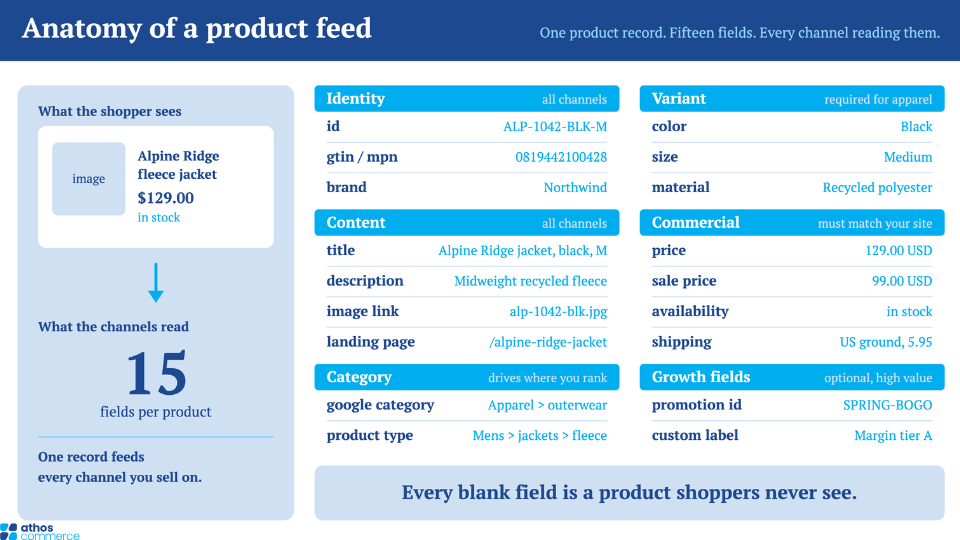
Most channels expect the same core building blocks, even when they ask for them in a different format.
- Identifiers: Each product needs a stable ID, GTIN, MPN, and brand so platforms can match your listing against known products.
- Product titles and descriptions: These fields carry the words shoppers actually search for, which makes them the strongest lever in feed optimization.
- Product categories: Google product taxonomy and category breadcrumbs tell the search engine where your item belongs.
- Variant attributes: Size, color, material, age group, and gender separate one listing from the next.
- Commercial data: Price, availability, shipping, and promotions need to update in real time to match your online store.
Why is feed management different from a one-time upload?
Catalogs change daily. Platforms change their requirements on their own schedule. A feed that passed validation last quarter can start collecting disapprovals this week because inventory shifted or a channel tightened a rule. Feed management tools handle that drift automatically, applying rules and templates so a single change in your ecommerce platform reaches every sales channel correctly.
Why Does Feed Quality Determine Ad Performance?
Poor product data limits visibility across Google, Meta, affiliate networks, comparison shopping engines, and AI-driven discovery. It also drags down ad performance directly, because campaigns cannot earn clicks on listings that never surface in search results.
The starting point at David Jones showed clear room for improvement. Sathish Poonath, Customer Success Director at Athos Commerce, found product data with “very few attributes” and identified “a lot of disapprovals” during his audit.
Missing attributes, inconsistent taxonomy, and feed errors mean products simply do not appear when potential customers search. The listings that do appear often fail to earn the click. The manual work required to hold that line grows every month.
“Some of those core elements to our product feed and then into our Google Merchant Centre meant we had a significant amount of manual uplift to actually enrich that feed, maintain it, but then also make sure that our disapprovals were always kept in check.”
Alex Carter, Head of Digital Experience & Operations, David Jones
Which feed problems cause the most damage?
| Feed problem | What it costs you |
| Missing or thin product titles | Listings lose relevance for high-intent queries and fall behind competitors. |
| Inconsistent product categories | Products land in the wrong comparison sets and lose product visibility. |
| Unmapped required attributes | Google Merchant Center disapproves the item and removes it from ad campaigns. |
| Stale price or stock data | Shoppers hit mismatched landing pages, which damages customer experience and account health. |
How Do You Fix a Broken Product Feed?
The work follows a repeatable order. Audit first, restructure the underlying product content second, then automate so the fixes hold.
Start with a full feed audit
An audit surfaces existing errors and uncovers opportunities that never made it into the feed at all. As Alex Carter described it, “We quickly identified that one of the biggest priorities was improving the stability, reliability, and overall quality of product data all the way through. It clearly underpins both customer and channel performance.”
Rebuild titles, categories, and descriptions
At David Jones, titles were rebuilt to lead with brand, size, and color. Product types and category breadcrumbs were standardized. Descriptions were cleaned, missing fields were filled, and values were mapped to match what each advertising channel expects. These are small edits individually. Applied across a full product catalog, they change how platforms interpret and rank every listing.
Automate the maintenance
Manual updates do not scale past a few hundred products. A rules-based, template-driven setup keeps the feed accurate without daily intervention.
- Rules engines: These standardize attributes like size, color, and product type across the entire catalog at once.
- Channel feed templates: Templates format your data correctly for Google, Meta, social commerce platforms, and each online marketplace you sell on.
- Automated cleanup: Titles, descriptions, and values are corrected at scale instead of one product listing at a time.
- Disapproval monitoring: Ongoing checks catch issues before they pull products out of your advertising campaigns.
The Athos Commerce Channel Assistant runs automated feed audits, flags problems before they trigger disapprovals, and syndicates optimized product data across more than 1,400 partner feed templates.
How Do Small Feed Improvements Compound Into Revenue?
Once the foundations hold, the team can shift from repair work to testing. That shift is where the commercial return shows up.
“Small, minor improvements can make as much of a change as large ones. That agility and ability for us to start testing and learning at this point was really helpful.”
Alex Carter, Head of Digital Experience & Operations, David Jones
What should you test first?
Test one variable at a time and measure it against a control. Ahead of Mother’s Day, the David Jones team tested keyword additions in product titles. That single test produced a 62% increase in revenue for the segment. James Foster, Media Implementation Account Director at Hearts & Science, saw the same pattern hold across campaigns. “These tests generally give us clear, actionable learnings that help us drive incremental traffic and revenue. Now, they’re solidified as part of our BAU strategy.”
How does feed data improve promotions?
Clean feed data replaces blanket discounting with precise targeting. “We were able to target specific categories, products, and brands where we knew that we would see much better value and a profitable promotional program,” Alex explained. Since adding promotions to the feed, David Jones has recorded a 43% uplift in click-through rate.
Athos Commerce: Your Partner in Product Data Feed Management
Retailers with strong data foundations stop reacting and start building. They add channels, test faster, and scale what works instead of patching disapprovals week after week. Athos Commerce supports that shift through auditing and identifying data gaps, structuring and enriching product feeds at scale, aligning feed data with campaign strategy, running continuous testing, and connecting performance data back to feed decisions.
The sooner your product data is clean, the sooner every channel you sell on starts earning its budget. Request a demo of the Athos Commerce feed management platform and see where your feed is leaking revenue.
Frequently Asked Questions
How often should product feeds update?
Price and availability should sync in real time, or at minimum several times a day. Attribute and content changes can follow a scheduled cadence, since those fields change less often.
What is the difference between a product feed and a product catalog?
Your product catalog lives inside your ecommerce platform and holds every record about a product. A product feed is the structured file you send outward, containing only the fields a sales channel accepts in the format it requires. One catalog can produce dozens of different feeds.
Why do products get disapproved in Google Merchant Center?
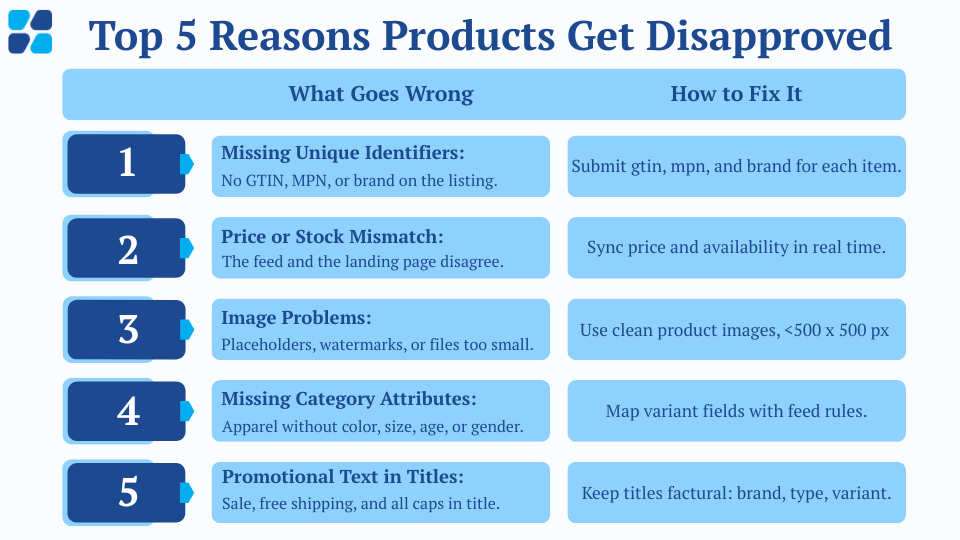
Most disapprovals trace back to a small set of causes. Missing identifiers such as GTIN or brand, price and availability that do not match the landing page, restricted product content, and image problems account for the majority. Automated monitoring catches these before they pull a product listing out of an active campaign.
How do you write product titles that perform?
Lead with the attributes potential buyers search for. Brand, product type, and variant details like size, color, and material belong near the front of the title. Keep titles readable rather than packing them with repeated terms, because search engines and shoppers discount listings that read as spam.
Do product feeds affect AI shopping tools?
Yes. AI assistants and shopping agents read structured product data rather than browsing a site the way a person does. Detailed information in the feed determines whether your products appear in those recommendations, so feed quality shapes visibility on emerging channels too.
Do you need feed management software for a small catalog?
A single channel and a few dozen products can be managed by hand. The math changes once you sell across multiple different platforms, since each one wants its own format. A feed management tool removes that manual work and keeps the data consistent everywhere.