






The question your product catalog couldn’t answer
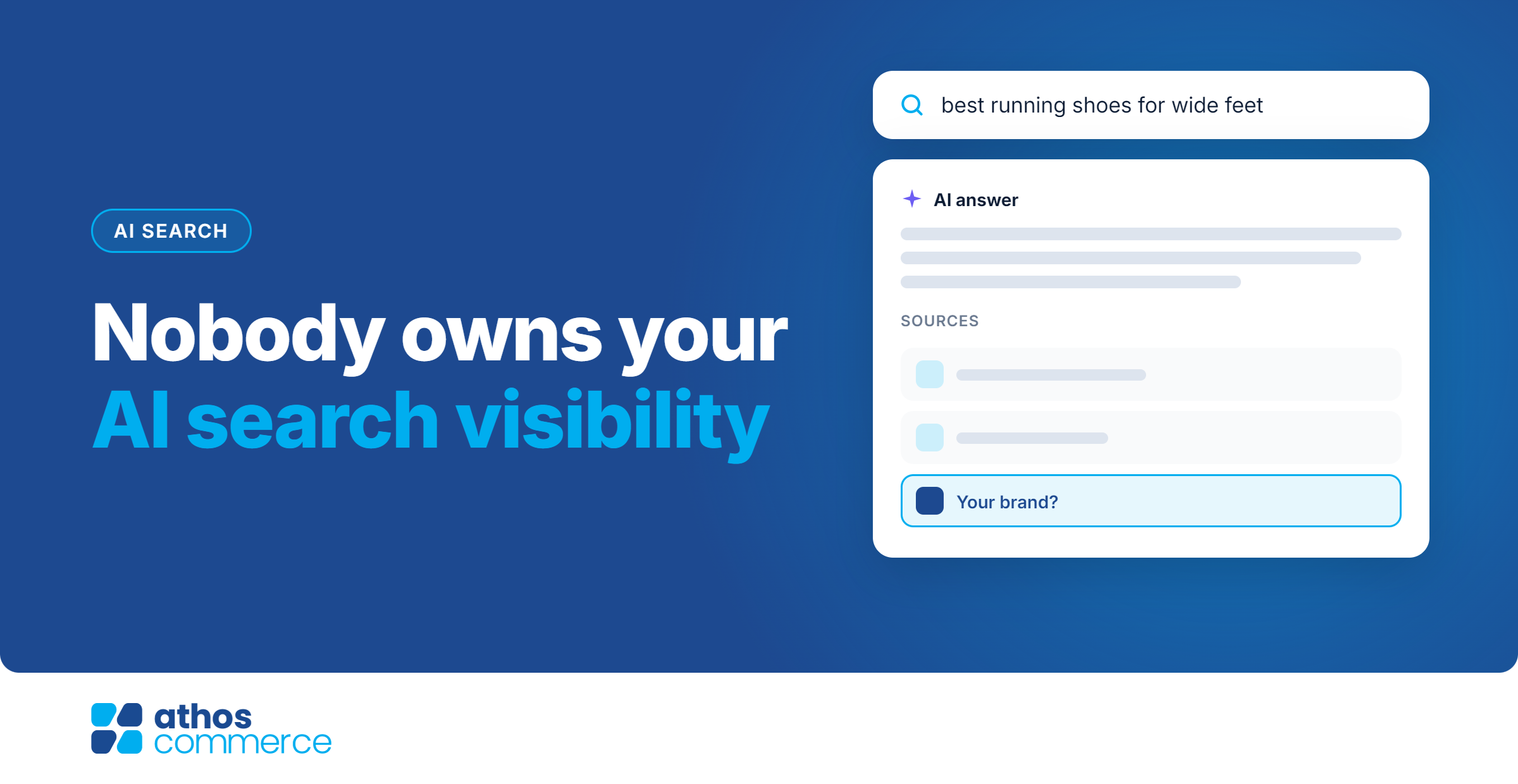
A shopper asks an AI agent for a “coffee color hoodie.” Your catalog has the product, but it’s listed as brown. The agent can’t make the match, and the hoodie never appears in the results. One missing synonym, one lost sale, and you never know it happened.
That example illustrates a gap that runs across nearly every product catalog in ecommerce today. Suhas Gudihal, CTO of Athos Commerce, estimates that fewer than 10% of merchants have machine-readable product data.1 Most catalogs carry three to four attributes per product, while agents need dozens to match a shopper’s query with confidence. As agentic commerce accelerates, that gap becomes a growing revenue risk. The remaining 90% of catalogs are either invisible to agents or generate answers so incomplete that the agent moves on to a merchant with richer data.
The consequences are already measurable. In an Athos Commerce and Pixel survey of more than 800 shoppers, 80% said they have abandoned a site because they couldn’t find what they were looking for.2 Agents make that same decision faster, with no second visit and no chance to recover the session. We explored the full strategic framing of this shift in our earlier post, Your Data Is Your Storefront.
Five questions agents ask that most product catalogs can’t answer
AI shopping agents evaluate your products by asking shoppers-specific questions. Each question maps to a data category, and an unanswered one is a reason to skip your products.
- “Is this easily assembled?” This is the structured attributes gap, and it’s the most common failure. Shoppers ask conversational questions about suitability, care, compatibility, and use cases that product descriptions were never written to address. “Is this fabric breathable?” “Will this fit an 8-year-old?” If the answer exists only in a marketing paragraph and not as a structured, machine-readable attribute, the agent can’t extract it. Gudihal sees this pattern across nearly all of Athos Commerce’s customers.
- “Will this arrive by Friday?” Shipping speed and handling time need to be in the feed as structured data per product, not buried on a site-wide policy page. If your feed doesn’t include an explicit delivery estimate, agents will favor merchants whose feeds do. (For the full Trust Stack framework, see our webinar recap.)
- “Can I return this if it doesn’t fit?” Agents won’t commit to a purchase without explicit policy data embedded in the feed. Return windows, restocking fees, and exchange terms need to be structured at the product level so the agent can factor them into its recommendation with full confidence.
- “Is this well-reviewed by people like me?” Agents perform sentiment synthesis, reading the actual text of reviews to answer questions about fit, durability, and suitability. Star ratings alone aren’t enough. The Athos and Pixel survey found that 76% of shoppers rate reviews as important or very important, with written reviews (58%) far outweighing star ratings alone (15%).3 Agents apply that same weighting, and if your feed lacks integrated review data, you pay a visibility penalty while the agent sources social proof from third-party sites you don’t control.
- “What else works with this?” Compatible accessories, bundles, and substitutes represent relationship metadata, and most catalogs don’t structure this data. When agents can upsell or suggest an alternative from your catalog because a primary product is out of stock, you keep the sale. Without relationship metadata, the agent sends the shopper to a competitor for the accessory, and often the original product goes with it.
“90% of my customers’ product descriptions miss out on all of those things, because somebody will ask, ‘Is this easily assembled?’ You don’t put that in the description right now.” — Suhas Gudihal, CTO, Athos Commerce.4
Every unanswered question is a product that an agent skipped, and at scale, those skipped products add up to a visibility gap that grows wider every week.
Agents already know what your product feed is missing
AI agents already generate feedback that tells merchants when a product was bypassed because a shopper’s question couldn’t be answered from the feed data.5 That turns the gap between what your catalog provides and what agents need into something your competitors can measure and act on before you do. The merchants who respond to that signal first will build an advantage that compounds over time.
The coffee-and-brown synonym problem captures why manual effort can’t keep up. That’s one product and one missing synonym. Multiply it across thousands of SKUs, dozens of attributes per product, and a growing list of AI platforms that each evaluate data in slightly different ways. A team managing 5,000 products across Google Shopping, Bing, and ChatGPT would need to review and enrich tens of thousands of attribute fields. By the time they finished, the catalog would have drifted with new inventory, updated pricing, and seasonal changes. The product data enrichment challenge is fundamentally one of operational scale.
How to close the product data gap
AI-powered enrichment tools change the math on what’s operationally possible. During the Athos Commerce March webinar, the team demonstrated a feed audit that analyzed an entire product feed in minutes, identifying that 85% of products had titles too short for AI discoverability and ranking every attribute gap by its impact on visibility.6 The platform’s image recognition and generative AI models extract missing attributes from existing product images, titles, and descriptions, turning a months-long manual enrichment project into a continuous process as your catalog changes.
Not every attribute carries equal weight with agents. When prioritizing enrichment, focus on three areas first.
- Structured product attributes such as materials, dimensions, and suitability indicators answer the conversational questions that agents most frequently evaluate.
- Fulfillment data matters just as much. Shipping speed, handling time, and return policies per product give agents the confidence to complete a purchase.
- Integrated review data with aggregate ratings, review counts, and verified purchase flags provides the trust signals that agents use to rank you against alternatives.
Start with your top-revenue products and expand from there. Athos Commerce’s Channel Assistant and GEO Assistant, part of the company’s feed management and intelligent discovery platform, handle the ongoing work of enrichment, synonym mapping, taxonomy alignment, and syndication across Google Shopping, ChatGPT, and emerging AI platforms. Product feed quality improves continuously rather than degrading between manual updates, which is the foundation of effective Generative Engine Optimization (GEO) and Answer Engine Optimization (AEO) for ecommerce.
Gudihal has seen this pattern play out before. In his previous companies, regulatory and market shifts rewarded organizations with data infrastructure already in place, from post-9/11 food traceability mandates that drove 200-300% growth to FDA-approved cancer diagnostics that achieved 97% accuracy through structured data.
In the next post in this series, he shares what those experiences taught him about the window of opportunity in agentic commerce and why the merchants who invest in product data enrichment now will be the ones who win.
See the AI-powered feed audit in action and learn how Athos Commerce helps merchants close the product data gap. Watch the webinar replay →
Suhas Gudihal
FAQs
What percentage of product catalogs are ready for AI shopping agents?
Fewer than 10% of merchants have machine-readable product data today, according to Suhas Gudihal, CTO of Athos Commerce. Most product catalogs list three to four attributes per product, whereas AI agents need dozens to match a shopper’s query with confidence. The remaining 90% of catalogs are either invisible to agents or produce incomplete answers, prompting agents to move on to merchants with richer, more structured data.
What data do AI shopping agents need from a product feed?
AI agents evaluate products across five key categories. Structured product attributes (materials, dimensions, suitability) answer conversational shopper questions. Fulfillment data (shipping speed, handling time) tells agents when the product will arrive. Policy data (return windows, restocking fees) gives agents confidence to complete a purchase. Trust signals (ratings, review counts, verified purchase flags) help agents rank products against alternatives. And relationship metadata (compatible accessories, bundles, substitutes) lets agents upsell or suggest alternatives within your catalog.
Why do AI agents need structured attributes instead of product descriptions?
AI agents can’t reliably extract answers from marketing paragraphs or unstructured text. If a shopper asks an agent whether a piece of furniture is easy to assemble, the agent needs that answer as a structured, machine-readable attribute in the product feed. When the answer exists only in a product description, the agent either hallucinates a response or skips the product altogether. Athos Commerce estimates that 90% of product descriptions lack the structured attributes agents require.
How do product reviews affect AI agent recommendations?
AI agents perform sentiment synthesis, reading the actual text of reviews to answer detailed shopper questions about fit, durability, and suitability. A survey of 800+ shoppers by Athos Commerce and The Pixel found that 76% rate reviews as important or very important, with written reviews (58%) far outweighing star ratings alone (15%). Feeds that lack integrated review data with aggregate ratings, review counts, and verified purchase flags pay a visibility penalty as agents source social proof elsewhere.
How can merchants close the product data gap for AI agents?
Start by prioritizing three enrichment categories for your top-revenue products. Structured product attributes like materials, dimensions, and suitability indicators answer the questions agents evaluate most frequently. Fulfillment data, including shipping speed and return policies, gives agents confidence to complete purchases. Integrated review data provides the trust signals agents use for ranking. AI-powered feed management platforms like Athos Commerce can automate this enrichment using image recognition and generative AI, completing in minutes what would take teams weeks to do manually.
Sources & Further Reading
- Suhas Gudihal, CTO interview. Athos Commerce, February 17, 2026.
- Athos Commerce and The Pixel. “The Discovery Gap: What 800 Shoppers Reveal About Product Discovery.” Research report, January 2026.
- Athos Commerce and The Pixel. “The Discovery Gap: What 800 Shoppers Reveal About Product Discovery.” Research report, January 2026.
- Suhas Gudihal, CTO interview. Athos Commerce, February 17, 2026.
- Suhas Gudihal, CTO interview. Athos Commerce, February 17, 2026.
- Athos Commerce. “Beyond Data Feeds: Winning the Shift to Agentic Commerce.” Webinar, March 4, 2026. https://athoscommerce.com/webinars/winning-the-shift-to-agentic-commerce/